Canadian Earth Science for @PMHarper – Preamble

In 2007, Canadian writer Yann Martel became puzzled about what made then relatively new Canadian PM Stephen Harper tick.  This as a result of a visit to Ottawa on the occasion of the 50th anniversary of the Canadian Council for the Arts, where Harper didn’t show. Yann Martel then decided to send Stephen Harper a novel of his own choice, at his own expense, every two weeks. You can read more about this interesting initiative here and here.  “I don’t know how you can be a thinking person and never read literature” was one of Martel’s explanations for his initiative. After nearly four years, Martel stopped building the PM’s library.

We are nearly seven years further. Stephen Harper is still Prime Minister of Canada and not only has there been a slash-and-burn of cultural infrastructure under his reign, his government has launched nothing but a killer attack on Canadian science. In the minds of Stephen Harper and his cabinet, scientists are spoiled ivory tower star gazers without an ounce of practicality or realism. They need to be brought down to earth and produce research that is applicable (in the short term) and helps “business”.

Intelligent and articulate protests have erupted as a reaction to this dumbing down of the Canadian knowledge infrastructure. Two initiatives stand out: the efforts to try to save the Experimental Lakes Area from being rolled up and the “Evidence for Democracy” initiative. I applaud, cheer and support these initiatives wholeheartedly.

What can the individual do faced with so much blatant ignorance and contempt for knowledge? What makes this PM and his ministers tick? Do they have any clue at all about how knowledge evolves?

Then it struck me: Yann Martel provided us with a model. So I’m going to be a bit of a copycat and I hope he won’t mind. Here is my plan:

On this blog, I will discuss a geoscientific article from peer-reviewed literature once a month starting this month (Dec. 2013) and continuing at least until the next Federal election in 2015. My discussion will be aimed at the general public. My goal is to discuss the article in the context of fundamental scientific as well as societal relevance. The article’s first author will be a Canadian scientist based in Canada. Preferably, the journal will be Canadian as well, but not necessarily. The article will be less than 5 years old.

I will attempt to cover the earth sciences in the broadest sense: my academic training is in geology, physical geography and marine sciences, so I am supposed to have the intellectual tools. I am not judging these papers. What I think of them is completely irrelevant – the eventual collection will – hopefully – be an decent cross section of Canadian earth science research, no more, no less.

As I thought about the model for this series, I realized I had developed one myself earlier. When I taught (sedimentology, stratigraphy, oceanography), one of the assignments I gave my students was called the “Chinese grandmother” assignment, a.k.a “Harvey’s hitch hike home”. The students were given the task to select a scientific paper less than 15 years old and less than 15 pages long from one of 5 different journals that I picked. They were to summarize the paper in their own words in less than 2 pages (12 point, double spacing).

The exercise was designed as a method to help them understand research papers: if you can explain the paper to your roommate who majors in political science, you probably understand it.

I called it the “Chinese grandmother assignment” because in the days before live streaming and skype, I had a brilliant Chinese PhD student in my program who taught me an important lesson: at the university in question, the defending candidate was required to present his/her work to the general audience (the family and friends) before the committee arrived. This student had a friend with a video camera ready – he looked at the audience, explained that his biggest fan had been his grandmother and that he was going to present his work to his grandmother (in China) because she sadly couldn’t be at his defense. He then looked into the video camera and managed to explain a complex topic in computer science in crystal clear manner (in English, thank goodness).

What an example! I named my assignment after him. Years later, I met a geologist (first name Harvey) who told me that, during the years that he was working on his PhD, he would hitch hike home on weekends and that the friendly drivers who gave him a lift always asked him about his research. Thus, he got to talk about his research to complete strangers in the relative quiet of a car for about an hour and he was sure that these exchanges helped him greatly during his research.

And so, I have a model: this is my own Chinese grandmother / Harvey’s hitch hike exercise. I hope I will do as well as my students did over the years – I hope I can live up to their expectations.

I found the first paper – I better start reading.

Posted in Canadian Earth Science for @PMHarper | Tagged , , , | 4 Comments

The King of Sand: Paul Edwin Potter

I only ever truly loved two textbooks. I only ever loved these books because they were capable of captivating my attention, enhancing my understanding, and making me realize the depth of the subject. Most textbooks are poorly written encyclopedias that should be thrown out, no matter how beautiful they look and how famous their writers. No matter how relatively useful they are.

The first textbook I ever truly loved was ‘Sand and Sandstone’ by Francis Pettijohn, Paul Potter and Raymond Siever. It was first published in 1972 by Springer. I used a library copy during my MSc studies, wanted to own it right away, but couldn’t afford it until I was a professional with a real salary. I bought it in 1984. The second edition was published in 1987 and you can still buy it for $239.00 (ex shipping). YES! I am obviously not the only one: this must be a darn good book if Springer can still sell it for that price 26 years after it was published!

Sand and Sandstone

What was it about this book? Opening it again after many years, I can’t really find a specific page to bring me back to that feeling of excitement. Maybe it was its inviting language: on page 7 the young student reads: ‘just where is sand in the world today…?’ Or maybe it was because the book was actually the result of a workshop and therefore reads as a workshop discussion, something I wasn’t really exposed to as a student in the Netherlands. For example, on p. 107 we read “Truly massive beds of sand appear to be very rare which is indeed fortunate, for if they were common, we would be hard pressed to explain them”, showing that the writers aren’t all-knowing wizards, they are real human beings with questions.

But they were confident researchers! The paragraph on Sandstone Petrogenesis has the following subsections: The Question, The Hypotheses, The Evidence, The Verdict. The Question is whether Climate, Tectonics, Provenance or Depositional Environment is the most important influence on the petrographic character of a sandstone. The Verdict: Tectonics – a textbook with sections written as a whodunnit, terrific.

Maybe I was simply excited about this book because I was from the Netherlands, a country with next to no rock outcrops, consisting largely of sand, mud and peat and locally a lot of glacial erratics (certainly in my home town, because I grew up on a moraine) – and here was something that made all that home grown dirt a Science!

Of the three authors of Sand and Sandstone, I only ever met Paul Potter once when he gave a talk about his research on the tectonic signature of the beach sands of South America. He published a lot on that topic – extremely elegant papers mostly in the rather obscure ‘Journal of Geology’.

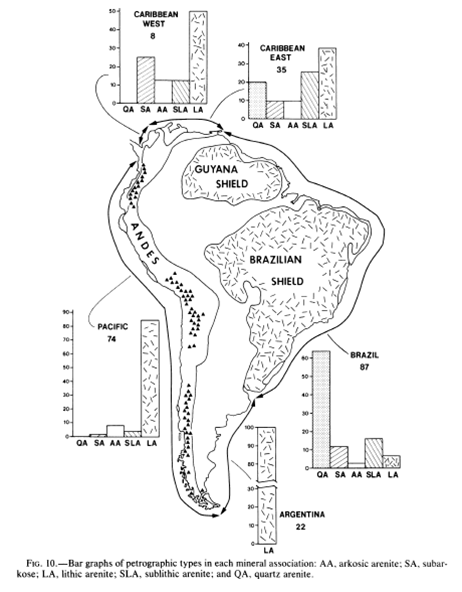
Those articles on the modern sands of South America are true gems. I have routinely used the three referenced below here when teaching sedimentology. Paul Potter asked a simple question: “how can we reconstruct ancient continents on the basis of sandstone petrology”? Obviously: by studying a modern continent, one that is properly situated and nicely varied (geologically speaking). Collect a few hundred samples (he calls it his ’18 year hobby project), process and analyze them in the same consistent manner – and plot the results:

Potter 1986 fig 10 Potter, 1986, Fig. 10

The beach sands of the Pacific province reflect an active continental margin, dominated by volcanic rock fragments (L).
The Brazil province reflects an eroded shield and the Amazon Basin, a typical passive continental margin – most of the quartz is monocrystalline.
The Caribbean is split in a western and eastern province. The western province has mostly volcanic lithics, whereas the eastern province has a Q/F/L of 69/8/23 and the lithics are more metamorphic lithics
Argentina has a misleading signature, suggesting an active margin, but this is of course a passive margin. The signature is explained by the fact that Patagonia is narrow and the climate dry.

There is a wonderful interview with Paul Potter on http://www.minutegeology.com – I have no idea who put that site together, but it’s worth checking out – nothing but interviews with highly respected earth scientists. Paul is very modest about his own accomplishments, giving mostly credit to his colleagues and characterizing himself as “someone who happens to be fairly good at finding a rose in a field of weeds”, a statement that implicitly refers to Kuhn’s “Structure of Scientific Revolutions”. Kuhn defined most scientific practice as ‘ordinary mopping up’. Paul Potter says that “ordinary science is nuts and bolts”, that “someone sometimes has an idea” (that sticks out) and defines the concept of Sequence Stratigraphy as such an idea. I think that “being able to find a rose in a field of weeds” is also proof of being in the business of generating ideas. Deciphering the tectonics of a whole continent on the basis of a few hundred beach samples is definitely an original idea.

References

http://www.minigeology.com

Pettijohn, F. J., P.E. Potter and R. Siever, 1987, Sand and Sandstone. Springer Verlag, 618 p.

Potter, P.E., 1983, South America and a few grains of Sand. Part I: Beach Sands. The Journal of Geology, v. 94, no. 3, p. 301-319

Potter, P.E., 1984, South African (error! should have read ‘American’) modern beach sand and plate tectonics. Nature, v. 311, p. 645-649

Posted in General geoscience | Tagged , , , , | 6 Comments

SWITCH – The Future of Energy – @SwitchEProject

Earlier this week I watched the SwitchEnergyProject film (www.switchenergyproject.com) for the second time. I first saw it last February when the Atlantic Geoscience Society showed it at its annual conference. This time I saw it at Wolfville’s Al Whittle Cinema/Theatre, hosted and organized by Acadia University and the Eco Kings Action Team (this being Kings County) as one of the activities during this sustainability week.

If you don’t know about this film, you should at least check its website; better, you should to watch it. I’ll give you the short version here:

The film was conceived by Scott Tinker, a geoscientist / petroleum geologist who is director of the Bureau of Economic Geology (BEG) in Austin (Texas, USA). The Bureau is the equivalent of the Geological Survey of Texas.

Since there is a lot of oil and gas (and lignite) in Texas, many BEG geoscientists are involved in research that pertains to fossil fuels and thus to energy questions. Many years ago, I was one of them.

SWITCH asks whether and when society will be able to make the switch from fossil-fuel-based economies to carbon-free economies. The approach that Scott Tinker takes, is novel – he calculates the energy requirement of literally everything a person uses (food, clothing, gadgets, utilities, holidays, etc.). This energy consumption per global citizen per year amounts to 20,000,000 watt hours for an average global citizen (the average US citizen uses 95,000,000 watt hours). Then he figures out how many of these 1-person-energy-demands can be supplied by different forms of energy: coal, oil, gas, hydro, solar, biomass, wind, geothermal. In this manner, he has generated is a standard to compare how well different energy sources perform.

The documentary is no great cinema – it portrays Scott traveling around the world, visiting a gigantic open pit coal mine in Wyoming’s Powder River Basin, an innovative hydro dam in Norway, a geothermal plant and the Blue Lagoon in Iceland, nuclear power plants and nuclear waste storage (to be recycled!) in France, the International Energy Agency, the very articulate US assistant secretary of Energy (nice view of the Smithsonian castle in the background), a solar power plant in Spain, wind turbine fields in Denmark (offshore) and in Texas (in a depressed agricultural region – I found this section particularly inspiring), an LNG terminal in Abu Dhabi, a biomass farm in Louisiana, a Tesla car dealership somewhere and experts in all these technologies in various places around the world (among them is the newly appointed US secretary of energy Ernest Monitz before he held that position). A lot of talking heads, but they do have interesting things to say.

The short conclusion is: it’s no wonder the world is addicted to fossil fuels, because they are easy to find, easy to transport, amazingly efficient and effective, relatively cheap and plentiful. Unfortunately, as we all know, their massive use is changing climate drastically, so we have no choice but to wean ourselves from them. The documentary seeks to find out how and when we can decarbonize our energy use, a term that Scott Tinker’s predecessor at BEG, the legendary Bill Fisher, already used in the 1980s.

Decarbonization is easier said than done. The only alternative that is more efficient for generating power (excluding transportation for the moment) is nuclear energy, but society has issues with that as well. The wind and the sun are intermittent (even exorbitantly sunny places have this nasty phenomenon called ‘night’), requiring at least some form of energy storage. Both wind and solar are regionally limited, as is geothermal energy. Although more ubiquitous, fossil fuels are regionally limited too: France has none, hence it relies on nuclear energy for all its power generation; Iceland has none, which it can compensate to some extent with geothermal. Biofuels require lots of land, which is unattractive as it competes with potential food production and/or wilderness conservation. People in emerging economies (most importantly China and India but other countries on their heels) will want the same levels of comfort as we in the western world have, so global energy demand is not decreasing any time soon.

The great hope (for climate and thus for humanity) is rapidly developing new technologies that can eventually provide us with renewable energy and – to some extent – with energy storage capacity.

Scott Tinker’s calculations suggest – based on current knowledge – that the world may consume more green energy than fossil fuels by 2064 – the year of the Switch.

For some people, that’s unpalatable – i.e. way too far off in the future. It may be, for our planet and for our ever burgeoning population – it may not.

—–

Global energy supply and demand is an immensely complicated topic. I think this documentary is an honest attempt to communicate some of these complications. I think it is a reasonably realistic portrayal of the situation even though some issues are glanced over a bit too much. I did miss a somewhat deeper discussion of the future energy needs of emerging economies and developing countries. To quote from an IEA fact sheet on Africa, for example: “more than a century after the invention of the light bulb, most of Africa still goes dark after sunset – children cannot do homework… etc.”. The documentary does mention that emerging economies and developing nations “will want the same amount of comfort that we in the West have” but there is much more to it than just comfort. I know that Scott Tinker is well aware of these challenges, but the film doesn’t quite do justice to them.

—–

 The reaction from the Wolfville audience: Mildly to severely critical.

Some people thought the film lacked credibility because it was ‘funded by the petroleum industry’ (untrue), didn’t think the film should have covered the innovative hydro-electricity project in Norway ‘because they are the world’s largest energy consumers, even larger than Canada’ (what a nonsensical argument aside from it being untrue). I did agree with the comment that the issues surrounding shale gas (i.e. hydraulic fracturing /  fracking) received a somewhat superficial coverage: the film leaves us with the conclusion that the only problem with fracking is with waste water. I fear there is more to it than that.

When one of the panel members stated that “the solution to decarbonization is nicely presented in the film it’s nuclear”, there was deafening silence. There was also deafening silence when the same expert suggested that “the best option for green energy in our area is wind energy. Are we willing to put up those turbines?” For the readers: Kings County reversed a bylaw allowing commercial wind turbines last year, handing us back in the hands of the fossil fuel industry.

There was some mention of rapid technological advances in energy storage capacity and a reference to a lecture by Daniel Nocera at Acadia University earlier in The Fall (for more on Dr. Nocera ideas, see http://en.wikipedia.org/wiki/Daniel_G._Nocera).

The discussion exclusively dealt with power generation. Transportation was never mentioned.

I was disappointed in the depth and level of discussion. Do people who attend such events largely belong to the idealistic crowd who think that we can decarbonize overnight? Sometimes I have that impression.

After the event I walked out with an acquaintance. She thought that banning commercial wind turbines was a good move “because we haven’t begun to exploit solar yet”. That may be true, but what about the short term? Wind is a thoroughly developed technology, why wait until solar is more perfect? Because we use fossil fuel in the meantime…….. I turned to walk home – she got in her car, as she lives outside of town limits, in our gorgeous rural area where property taxes are an order of magnitude lower than in town………….

—–

Also this week I read two thoroughly researched articles on climate change: Paul Krugman’s review of William Nordhaus’s new book and Verlyn Klinkenborg’s review of Bill McKibben’s new book, both in the NY Review of Books.

Nordhaus’s book is an economic approach to the issue of climate change whereas McKibben’s book addresses moral questions. Nordhaus appears less pessimistic about our common future (sic) than McKibben. The reviewer of McKibben’s book characterizes him as a completely decent guy who is capable of still being naive.

I wonder if the Wolfville audience at the Switch film consisted largely of naive people….

Both Nordhaus and McKibben are passionately in favour of a carbon tax, which is not going to happen in the US and therefore not in the rest of the world before the US will have to set the example, which the current US political climate prevents. Scott Tinker, by the way, is also in favour of a carbon tax, as he made clear in a lecture that I attended about 3 years ago.

And that brings them together.

References

Klinkenborg, V. The Prophet. Review of B. McKibben “Oil and Honey: the education of an unlikely activist”, NY Review of Books, 24 October 2013

Krugman, P. Gambling with civilization. Review of W. Nordhaus “The Climate Casino: Risk, Uncertainty and Economics for a Changing World”. NY Review of Books, 7 November 2013

Posted in Energy | Tagged , | Leave a comment

A year later: women in (geo)science

It’s almost exactly year since I started this blog. My first post was dedicated to ‘Women in Geoscience’ Day 2012, followed by a dozen or so others, but I haven’t been very productive lately: my last post was 5 months ago. There is an explanation, of course, but it’s not very interesting.

Today is – again – Women in Geoscience day. What better day to crank my blog-effort up again? Even better for inspiration: Andrew Alden (@aboutgeology) mentioned my writings in his ‘women in geosciences’ blog post today (http://geology.about.com/b/2013/10/17/women-in-the-geosciences-day.htm). Wow! Me? Really? Goodness.

So here is today’s essay on Women in Geoscience. And I am going to guess that what I sketch here pertains to women in science in general, and possibly to women in anything else.

===

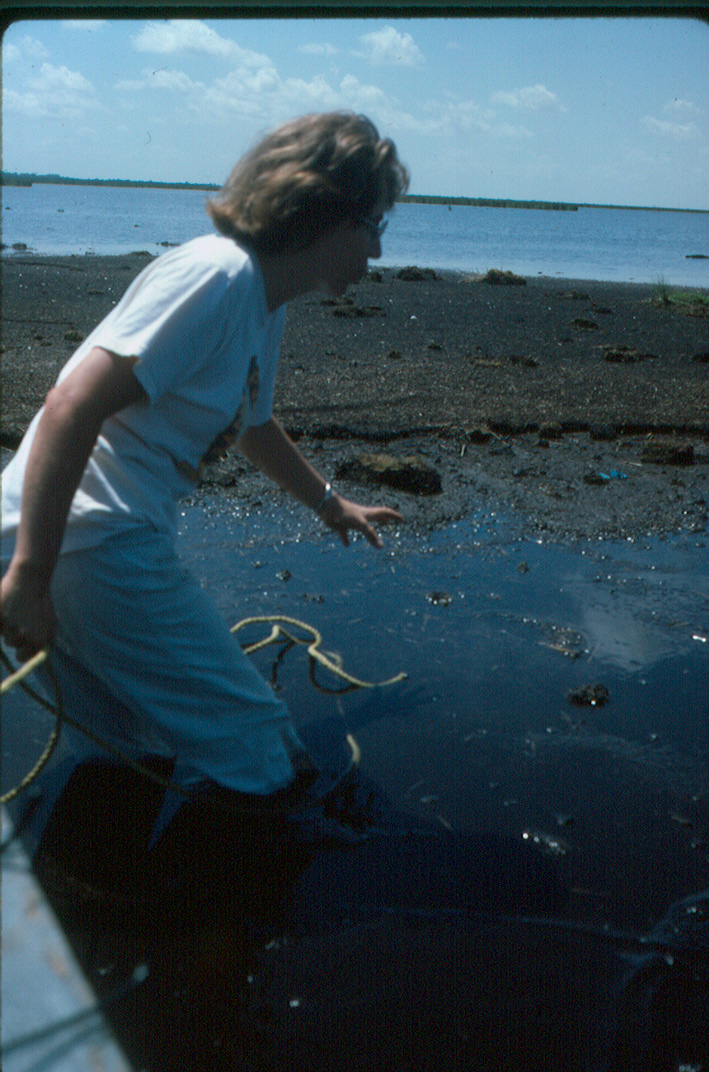
liesincoffeeground negotiating a decaying peat body, Mississippi Delta, ca. 1985

In the 1980s I worked in the coastal geology program of the Louisiana Geological Survey. Having grown up and studied geology (BSc) and Quaternary Geology (MSc) in the Netherlands, Louisiana was perhaps a logical destination (an Italian woman geologist friend said to me at the time of my move to the Deep South: “these Dutch people, they can’t stay away from flat delta plains”). There were about 7 of us, all contracted to provide the Government and the People of Louisiana with evidence-based advice on what to do about their rapidly disappearing delta plain (it’s still disappearing, by the way, but this post is not about governance). Incidentally, most of us were able to produce a PhD on the basis of our research, made possible by good personnel management of the LGS, but that’s another story.

Each of us (only 1 other woman) was responsible for research in specific areas of the delta: the offshore, the barrier islands, the river and – in my case – the peat deposits of the delta plain. Peat: black, gooey stuff, minimally decayed plant material mixed in with fine sediment. I treated peat as sediment – I am not a biologist, after all. But I was lucky to meet a very capable marsh expert / ecologist outside the Survey and she and I ended up collaborating productively for a few years. I learned a lot about plants, ecology and marsh dynamics.

Skip forward about three years: by now I had published papers, given talks at conferences and built up a bit of a network. Much to my surprise, my work was discovered by coal geologists who were interested in how peat could get preserved in deltaic settings (where we find a lot of the world’s coal seams).  But I also ended up at wetland conferences where I would be the lone earth scientist among ecologists and biologists. In short, I found myself at an interface between earth and life sciences. Because I was young and in a new country where I did not always feel very secure, this position didn’t necessarily feel comfortable. What was I? Would I still be taken serious as an earth scientist if I worked any longer on peat? Shouldn’t I try to leave and make an effort to become a ‘real geologist’? What was that anyway?

One evening I found myself sitting at a restaurant table with 3 other peat/coal women scientists: one was my ecologist/marsh expert colleague (and by now friend), two were classically trained coal geologists whose research had taken them into looking at modern coal-forming environments, i.e. peats. Mind you, this is 1987, the number of women geoscientists was a lot lower than it is today. We got a little giddy: there were four of us! Four women researching peats as modern coal analogues. And we knew of exactly one other person with the same research focus: another woman.

Serendipity? Just chance? Or would there be a reason?

A few glasses of wine and some deep discussion later, we arrived at a hypothesis: most male mammals, including homo sapiens, are territorial. They mark their territory diligently, making sure to smell out their competitors. Jump forward to practicing science: do male scientists instinctively claim a territory in which they can make their mark? A clearly defined subject, one that is recognized by other male scientists as a properly outlined dueling target? A delta consists of sandy framework facies – many textbooks and libraries have been written about the sedimentology of river and barrier island strata, but what to do with peat? It’s neither this nor that – it’s plant material, but becomes preserved as strata. That’s messy, that’s not a clear territory – let’s leave that for the girls.

If this dynamic does really work (often), then I really don’t blame the boys, it’s not a conscious decision and they can’t help it anyway.

It’s just really interesting.

Moral of the story: don’t be afraid to sit on the edge

ADDENDUM, OCTOBER 21

Only 2 days after publishing this post, I was made aware of an article by Curt Rice (@curtrice on curt-rice.com) entitled “The great citation hoax: proof that women are worse researchers than men”. It’s devastating analysis of how male scientists tend to cite themselves and other male scientists exponentially more and more often than female scientists. I feel strangely relieved because this supports something that I suspected a long time and that I had intuitively parked under the same ‘territorial behaviour’ label.

Posted in Women in geoscience | Tagged , , | Leave a comment

What Research does Society need / want? A reflection on cutting public science institutions

From 1997 to 2002 I was president of the Royal Geological and Mining Society of the Netherlands (KNGMG, www.kngmg.nl). One of my tasks was to present the Society’s highest scientific award, the “Van Waterschoot van der Gracht Medal”[1] to a worthy recipient each year.

In 2000, the recipient of this medal was Dr. Franz Kockel, a spirited German geologist who had just retired after having spent his entire career with the Bundesanstalt für Geowissenschaften und Rohstoffe / BGR, i.e. the German Federal Geological Survey in Hannover.

I reread my citation for Dr. Kockel and I believe that it is as relevant today as it was 13 years ago and so I have decided to reproduce it here with minor edits. I think it relevant because of what has been happening the last two years in Canada, where public science institutions are slashed in an unprecedented manner at the hands of the Conservative Harper government. These cuts are hardly based on evidence and they are so destructive that I believe it will take us decades to restore Canada’s public knowledge base.

The speech reproduced here is a justification of publicly funded research institutions as distinctly different from universities or from industry, driven by what society needs in the long term, but not by what society (or, as the Canadian government phrases it “business”) wants (in the short term).

I have added one paragraph, printed in bold

===

Dear Dr. Kockel,

(I skip the intro of the speech, where I welcome everyone)

In presenting you with the Van Waterschoot van der Gracht medal, I am taking the liberty to reflect on the type of organization that made your contribution to geoscience possible: a geological survey organization.

You are a representative of those in our geoscience community who work to serve the public. This role is distinctly different from those in industry or in Academia. The resource industry focuses on exploration and production of earth materials with the objective of making a profit on its discoveries. But the resource industry cannot be effective and efficient if it relies solely on its own investigations; it needs unbiased, spatially consistent regional information in addition to its own, location-specific information. Because only sharing knowledge enables the growth of knowledge, industry is aware that it must share information with public institutions and it does share its proprietary information (cores, logs, samples, seismic sections) in various ways with public survey institutions.

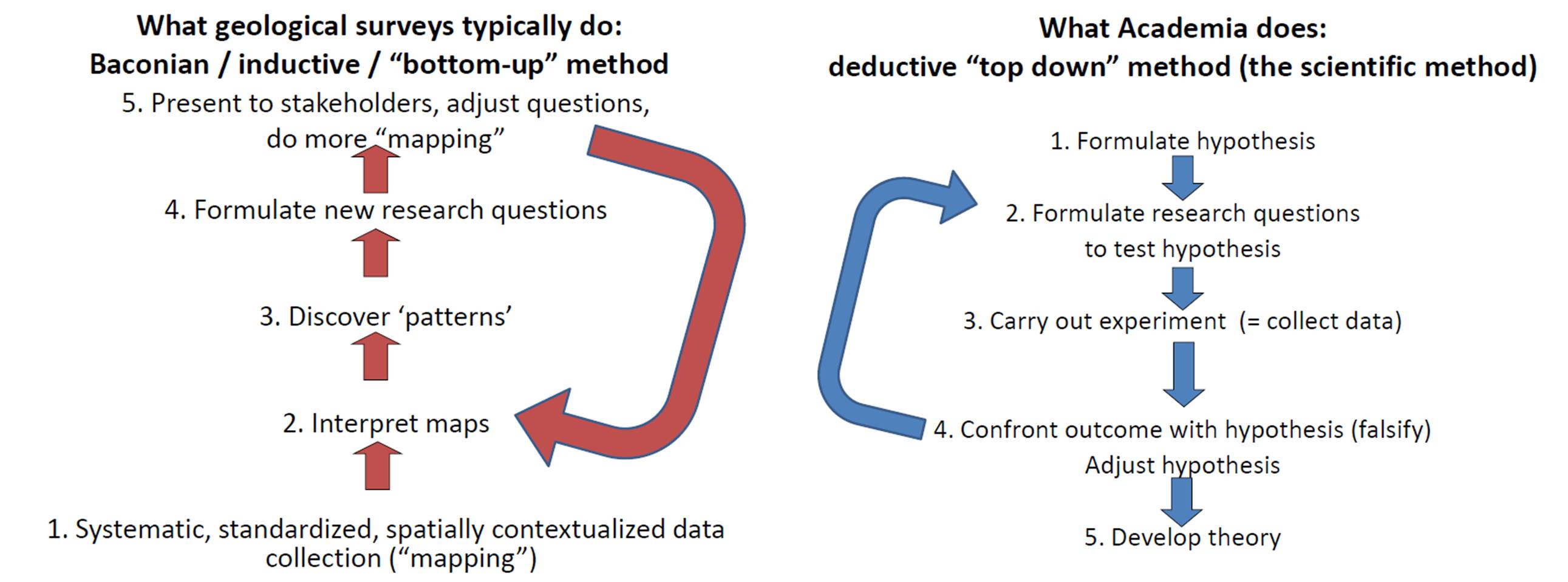
The role of geological surveys is also very different from that of academia, although they are both public institutions. The justification of university is the production of highly qualified personnel (graduates) and, in tandem, new knowledge. New knowledge produced by universities generally comes about in a different way than in a survey environment. The main difference between the two lies in the difference between deductive and inductive research methods. Deductive reasoning is the standard for Academia, but Geological Surveys must rely on inductive methods to produce the sort of knowledge that serves the broad public interest. Inductive research methodology leads to new knowledge, new questions and new insights just like deductive reasoning, and is none the less for it.

inductive deductive

Where else but in a geological survey can one be asked to be complete? Geological Surveys are the developer and custodian of the information that the taxpayer must have access to in order to enable decisions about investments in matters concerning the earth. Such investments are made by governments or by industry or in partnership. The knowledge produced, maintained and made accessible by Geological Surveys then enables a proper regulatory environment for the management of our natural resources.

This differentiation of roles appears simple and transparent. For many decades, the distinction between three types of institutions were essentially unchallenged and unquestioned. The need for Geological Surveys (and for comparable public institutions) dates back to the 19th century when many new Nation States had just been formed. Young governments needed objective and unbiased information on their natural resources in order to plan and justify investments in infrastructure, human settlement and resource utilization.

The explosive growth of Information Technology and novel ways of observing the earth and the new world order after the end of the Cold War has changed things. One of the consequences of these events is that national governments withdraw from direct meddling in the affairs of public institutions such as geological surveys: the apparent victory of capitalism (in Europe) means that the user has the final word and that government decentralizes. The idea is that public institutions must justify their place under the sun by carrying out work for which a user group is willing to pay.

Nobody denies that the secure and often hardly challenged position of many geological surveys had caused them to be a bit myopic, a bit too fat on the ribs and a bit too slow in their responses at times. Nobody denies that there was a tendency here and there to lose sight of their specific role. Nobody denies that a bit of a shake-up and a bit more challenge wouldn’t be healthy.

But we must ask to what extent we can allow the user demand to dominate the work of survey institutions, because most users have relatively short-term goals and needs. The government – as a user – generally finds it difficult to look ahead further than one election cycle, typically 4-6 years. With exceptions, notably in Canada (Duke, 2010), industry has fairly short term needs as well. Isn’t there a risk that the current trend threatens geological survey organizations to become technical service agencies? Are we in the process of giving society what it asks rather than what it needs? A technical service outfit will give the user what it asks, such as analysis of a sample set, interpretation of a set of cores. What society needs can only be articulated by intelligent leaders with a long term evidence-based vision about where society is headed, where it should head, and what tasks are necessary to support the desired direction.

The work of a geological survey scientist is becoming endangered and I doubt whether this will benefit society in the long run. You participated in many projects while at BGR, quite a few of which took you to exotic locations, but you are here today because of your accomplishment in leading the production of the structural Atlas of Northwest Germany and the German sector of the North Sea. This atlas is not only your main achievement, it was also originally your idea, based in the realization that the quick job of Alfred Brenz, who compiled a geotectonic atlas of northwestern Germany in 1947, deserved proper updating. Your project started with regional mapping of the base of the Cretaceous and evolved from there to include the detailed mapping of every meaningful stratigraphic interval over a period of 25 years.

It is difficult for geological survey instutions today to find and justify the resources necessary for a project of such significance. As a society, we must remain alert that we don’t lose the capacity that this sort of necessary, relevant, long term work is carried out and carried over.

(I exclude the more personal end of the speech).

References

Duke, J.M., 2010, Government geoscience to support mineral exploration: public policy rationale and impact. Prepared for Prospectors and Developers Association of Canada (http://www.pdac.ca/publications/enews/publications—enews/2010/10/06/october-6-2010—no.-74 ), 72 p.

Kosters, E.C., 2000, citation for Dr. Franz Kockel on the occasion of receiving KNGMG’s “Van Waterschoot van der Gracht Medal”. KNGMG/ALW Newsletter, 2000/8, p. 8-11.


[1] named after the iconic first director of the Netherlands Geological Survey, Dr. Willem Van Waterschoot van der Gracht, who was also instrumental in getting KNGMG off the ground. A short bio is at http://people.wku.edu/charles.smith/chronob/WATE1873.htm

Posted in General geoscience | Tagged , , , , , , | Leave a comment

Dreikanter: The biography of my favourite ventifact

dreikanter (photo E. Kosters)

This is my favourite ventifact, a real Dreikanter, a German word meaning ‘three sider’. This vernacular term became the formal label for a ventifact with three sides. My Dreikanter is a well-sorted pure quartz sandstone of a uniform grain size. It weighs 11 kg and shows cross bedding.

I found this beauty in 1978 in a sand pit just North of the small town of Lathen, located along the Ems River in northwestern Germany, close to the border with the Netherlands. The sand pit is still there (52o52’40” N, 7o19’25″E. This area was part of my MSc thesis research field area. It was a dark, grey day and I wasn’t feeling particularly upbeat about where my thesis was going, so spotting this stone lifted my spirits and I decided to take it with me. Unfortunately I don’t have a photograph of the “outcrop”, the wall of the sand pit. I plucked it out of a layer of many such stones (but none as pretty as this one), representing a Weichselian age periglacial desert pavement.

A periglacial desert pavement forms in the vicinity of a major ice cap, often on the edge of the outwash plain of such an ice cap. Two processes contribute to the formation of a desert pavement: frost heaving forces larger-size rocks to the surface and strong katabatic winds coming off the ice cap selectively remove finer sands and silts (easily done as there is virtually no vegetation), leaving a surface riddled with stones. Because the winds are generally from consistent directions, the stones are sand-blasted from those directions, over time shaping the stones into two-, three- or even four-sided ventifacts (literally meaning ‘made by wind’). The sand blasting often also leaves the stone smooth and shiny, a phenomenon that’s called ‘desert varnish’.

The process is illustrated here:

desert pavement formation (modified from Wikipedia)

The equivalent of the Illinoian glaciation on the North American Continent is the Saalien glaciation in northern Europe. The maximum extent of the Saale ice cap is shown as the yellow line on the figure below. The blue line represents the maximum extent of the Elster ice cap, which preceded the Saale. The red star indicates the location of my Dreikanter find.

EisrandlagenNorddeutschland (modified from Wikipedia)

The most recent glacial period in Europe, the equivalent of the Wisconsinan glaciation in North America, is the Weichselian. The maximum extent of the Weichselian is represented by the red line.

My Dreikanter was transported from somewhere in Scandinavia to its final resting point at the red star by the kilometers-thick ice mass of the Saalien glaciation. When the ice retreated, it left it there. I can’t tell you what happened during the subsequent Eemian warm period here, because I no longer have my field notes from those years, and so I can’t tell you if there is any evidence of soil formation at this locality.

But during the Weichselien glaciation, a desert pavement formed in this area. There are a lot of sand pits in this area and I visited quite a few of them during that field summer and almost all of them showed this thin desert pavement, riddled with ventifacts, and covered with fluvio-eolian deposits of the late Pleistocene River Ems (little or no vegetation in this periglacial desert, so plenty of opportunity for river dune formation), as was the case in this sand pit.

Where did my ventifact come from? I don’t really know, because at the time that wasn’t part of my research. Dedicated researchers have reconstructed individual Scandinavian ice streams on the basis of rock component proportions. Scandinavia is dominated by basement rock. A bit of searching leads me to believe that there is a good chance that my ventifact was plucked off an outcrop of the sandstones of the Vassbo Formation of southern Sweden (Wallin, 1990). The Vassbo Formation represents shallow marine and eolian deposits on the edge of the Baltica craton, which was located at halfway between the equator and the South Pole at the time of deposition. These are enigmatic sandstones, very uniform in grain size, having been deposited over vast shelf areas around continents that consisted of bare rock. Vegetation wouldn’t come in for another 100 million years. By the time my ventifact was plucked off its outcrop, the Baltica craton had migrated from about 45o S to about 60o N (over a period 500 million years, and not in a straight line) and then this piece (not yet a ventifact) traveled south, incorporated in the ice mass, for about 1000 km in – maybe – 10,000 years before coming to rest on the north German plains, where it was subsequently given its quirky shape by the relentless winds of the last ice age over a period of a few thousand years.

And then I picked it up and took it home. It was a great conversation piece. Two years later I moved to the US as a poor grad student, so couldn’t take my ventifact with me. My dad kept it in his study and it remained a great conversation piece there too for nearly a decade, when I returned to the Netherlands and took it to my house.

About 11 years ago, we moved to Nova Scotia and I took my ventifact with me. By complete accident, our house stands smack on top of a tiny alluvial fan, deposited under a ridge on the edge of the Minas Basin, an arm of the Bay of Fundy. The Holocene onlap is halfway up the back yard: Holocene marine sediments lap on to the gravels of the no longer active alluvial fan. An alluvial fan……….. in an area that was once under a thick ice cap……………. And yes, dozens of ventifacts surfaced when we excavated for the expansion of our house.

My Scandinavian ventifact has found a place in our Nova Scotia garden as the head of a not very convincing Inukshuk.

Now, I just wonder, if a future Acadia University geology student, say, 100 years from now when everyone will have forgotten that we ever lived here, starts an honour’s research project on ventifact rock types populating this alluvial fan, what is she going to think of this one?

Wallin, B., 1990, Early Cambrian coastal dunes at Vassbo, Sweden. Geological Society of America Bulletin, v. 102, p. 1535-1543

Posted in General geoscience | Tagged , , , , , , , , | 1 Comment

Women in (science) careers; it remains difficult

The Council of Canadian Academies released its report ‘Strengthening Canada’s Research Capacity; the gender dimension’ in November 2012 and organized a panel discussion on the topic on April 23, 2013. Read all about it here. This report came about after the embarrassing absence of any female nominees in the Canada Excellence Research Chairs Program, a prestigious and welcome nationwide injection of scientific super stars. I regard the Council highly and commend them on a job well done.

I am a woman geoscientist with 25+ years experience in government and academia and 10+ years as an independent. I have been close to two blatant instances of professional discrimination against women, one of which pertained to myself. I decided to write about these two cases here after all these years. I anonymized these stories for obvious reasons. The reason I publish them is to show how subtle and yet persistent the type of behaviour is that favours men. I don’t think either case is unique to science, this could happen anywhere where there are more men than women who pull the strings.

1.       Recruiting a Professor

More than a decade ago, I was a member of a recruitment committee for a full professor in an applied geoscience field in a reputable department of an equally reputable engineering university.

The committee had five members. Three were professors from the department itself and two were outsiders. One outsider was a professor from a different university, the other one was me. At the time I was a dean of research and graduate studies at a different institution.

This university had a history of recruiting industry professionals in a later stage of their career as professors. Typically, these people had impressive industry experience and a publication record, but not necessarily a PhD. Non-PhD professors were common in this institution.

In our first meeting, we discussed the job profile. There was some discussion about who might apply (it’s not a big field, we had a fairly good idea who might be interested) and one of the committee members, a full professor from the recruiting institution – we’ll call him Al – mentioned that he had talked to a woman we’ll call Sarah about this upcoming job opening and that he had encouraged her to think about applying (or words to that effect). Sarah did not have a PhD (nor did Al, incidentally), had worked for a large well-known corporation for 25 years and was widely respected. We all knew her. The committee made a unanimous decision that someone like Sarah would be a candidate of interest and that we thus should drop the PhD requirement.

The text of the advertisement reflected this position explicitly and it was published internationally. Five people applied, one of whom was Sarah. We knew three of the other applicants, one was a surprise.

There were two rounds of interviews. The committee eliminated two candidates after the first round, Sarah was one of the three remaining candidates. The final round evolved.

At this point, I should point out that the following rule was on the books in this university: if more than one candidate qualifies for a job, and if one of the qualified candidates is a woman, the job should be offered to the woman.

We gathered in a final meeting. All committee members (including myself) were especially impressed with the surprise candidate. I then asked the committee members if they thought all three candidates qualified. The entire committee agreed that all three candidates qualified. I then confronted them with the university rule cited above and moved that we offered the job to the woman. A heated discussion followed. It was clear that the three committee members from the department all wanted to recruit the surprise candidate. I agreed that this surprise candidate appeared impressive, but that the university had rules that we should abide by. “But” said Al, “she doesn’t have a PhD and we have been told by the Board of Governors (BoG) that we have too many non-PhD professors”.

Excuse me?

Before being published, the ad had been approved by the university’s personnel department, so I didn’t think that Al’s argument held water at all. If the BoG would indeed have been of this opinion, the personnel department would have been instructed accordingly and the ad wouldn’t have gone out as it did.

In the end, the three departmental committee members voted to recruit the surprise candidate. The other external committee member only cast his vote at the very end of the discussion. He stated that he didn’t want to go against the department’s wishes, because they had to work with the new colleague and he didn’t, but he made explicit that my position was basically correct.

I repeated that there was no question that the surprise candidate was excellent, but that offering him the job would be wrong. I stuck to my vote for the woman candidate.

My position created a difficult situation because these committees are expected to advise the BoG unanimously. I offered to write a dissenting opinion, to be submitted with the recommendation of the committee to the BoG. We went home.

The next day, one of my fellow committee members called me (at home!) to put the guilt trip on me. I was making life difficult for the committee chair, he wouldn’t be able to deal with the fall-out of the Board of Governors, this would reflect badly on the department, etc.

Excuse me?

I wrote my dissenting opinion letter and submitted it. I never heard anything. The surprise candidate was recruited shortly afterwards.

Conclusion: I was the token woman on the committee and the woman candidate was the token candidate. It was window dressing for the boys to play their own game.


2. How I failed to wedge in

I was dean of research and graduate studies at a small independent institute in the Netherlands for 7.5 years. It was an unusual institute in that it originally existed purely to train young professionals (with at least a BSc degree) from non-western countries (i.e. ‘the south’) in this particular field. It had existed for about 45 years as a post-graduate training institute and it was clear that – if you read the political tea leaves correctly – it would eventually become incorporated in the country’s existing higher education system.

The Netherlands has a three-tier higher education system as a logical follow-up to their 3-tier secondary education system: vocational colleges, polytechnical colleges, universities. The president of the institute thought that the institute deserved (eventually) to become part of the university system rather than the polytechnic system, where he was concerned it would end up. So, in order to make the case, the institute would need to be more prolific in research. While it was an innovative place, there was not a real research culture and the institute didn’t have the right to grant PhD degrees.

The president recruited me to produce an advisory report on how to move forward – this was an interim job of a few months. On completion and presentation of my report, I was invited to join the institute to carry out my own advice. The advice consisted essentially of two recommendations: 1) create a fair and transparent process to allocate research resources within the institute on the basis of merit and 2) build an North American style PhD program (with students formally graduating from Dutch universities).

At the time of my recruitment, the institute had two Deans (that wasn’t the official title, but it’s the title that best describes the positions): a Dean of education and a Dean of consulting. This latter position may seem unusual, but it was perfectly logical for this organization.

My position was newly created. When negotiating about my salary (it was a 5-year contract, i.e. no tenure, i.e. I accepted insecurity, which usually carries a higher price), the institute’s HR chief stated that their rank for this position was one level below what I was making at the time, but that they would continue me in my existing pay scale (all government institutions in the Netherlands have the same pay scales). I accepted that as it seemed fair. Only a year or so later did I find out that my two colleague deans were each one pay scale higher than me and that the HR chief had referred to two staffers who were clearly working at a level below me. Intentional? Misunderstanding? I’ll never know. At that point in time, I wasn’t too much worried about it, as there was a large overlap between these pay scales. For me, it wasn’t about money, but about recognition and I thought I’d get there.

Then the institute’s president retired, was succeeded by a new president who became a catastrophic failure and was asked to resign and then by another president. In other words, about 5 years of chaos – not a good time to negotiate job and salary conditions. I continued to receive very positive job evaluations over that period and waited for a better time.

When things settled down, I asked for my position to be re-evaluated with the explicit objective of moving one pay scale up. Now, if you want to be a successful dean of research, the one thing you shouldn’t do is build an empire of staff, because the academics will consider you a thief of their resources – rightly so. So I had not done that (I had been an academic myself, I knew). I relied on two capable financial guys in the business office and two capable staffers in the education office and one administrative assistant for myself.

With that support I had built a successful PhD program in a complex environment: the institute didn’t have the right to grant PhD degrees itself, so we built bilateral agreements with specific Dutch universities so that candidates could obtain a legal degree (and this required having 2 supervisors, indeed!). Time-to-degree averaged 4.5 years – the best in the country. I had also built in opportunities for non-PhD faculty to work on and obtain their PhD and built a fair resource allocation system.

I didn’t do this just with the few loyal staffers: I relied heavily on the institute’s scientific committee, consisting of 7 professors. This was the body that approved (or rejected) all my proposals. One of the reasons that I cooperated so well with this committee, was that I had an excellent working relationship especially with the committee chair, who kept that position the entire time I was there.

My position was finally re-evaluated. The job description was thoroughly analyzed, rewritten etc. A meeting was scheduled between the new president and the new HR chief and myself. They flatly informed me that the position couldn’t be formally reclassified because ‘not enough people were reporting to me’. In exchange they offered me a permanent position. I raged – this was certainly a very old fashioned way of looking at positions – and I had explicitly not built an empire! But I had to accept it. I considered resigning (I had two offers), but personal circumstances were unfavourable: my husband and I were planning to move (back) to Canada the next year.

Hence I resigned a year later. The institute then had to find a successor for me. It turned out that the chair of the scientific committee, my long-time loyal colleague, had an interest in the position. I thought that was fantastic because he knew all the ins and outs and I regarded him highly. Some day over coffee, I told the institute’s president as such. Now comes the clincher: “yes” he said “it’s great. Of course, we’ll have to do something about the job description, otherwise we can’t justify continuing to pay him in his current pay scale…………………”

Excuse me?

The scientific committee chair did get the position. We kept communicating by e-mail and he repeatedly informed me that he changed nothing in what I had set up as it was all working swell.

Some years later, the institute became a faculty of a nearby university.


Posted in Women in geoscience | Tagged , | 3 Comments

The 2nd Sichuan earthquake in 5 years / why we need more art in science communication

Yesterday, on April 20, 2013, an earthquake struck in China’s Sichuan province. Because this is the blog of an earth scientist, I’ll give you the link to the USGS’s report: http://earthquake.usgs.gov/earthquakes/eventpage/usb000gcdd#summary . This write-up is excellent and that’s how we know that this earthquake, together with a bunch of other deadly Chinese earthquakes, occurred on the Longmenshan fault belt, a thrust zone marking the eastern margin of the India-Asia collision zone. So much for tectonics.

The result of this week’s earthquake was a death toll of at least 150, and the number of injured numbers at least 5,700.

–          Buildings are flattened.

–          Someone reports ‘the longest 15 seconds of his life’.

–          there are heroic rescues.

–          International offers of assistance have been received.

–          condolences have come in from countries x, y and z.

–          People of authority offer their prayers.

–          Rescue efforts are hampered by landslides, some of which block crucial roads.

I copied the above observations from some of the write-ups on websites of reputable press agencies, it doesn’t matter which ones, they are all the same. And they are the same for each major earthquake that strikes.

And nothing changes. Because it’s not really the earthquake that killed people, it’s the buildings that collapsed on top of them.

Granted, this is a vulnerable area. Granted, it is densely populated, but it has about the same population density as equally vulnerable greater Los Angeles and greater San Francisco, where the death toll from the 1994 Northridge and Loma Prieta earthquakes was minimal: less than 100 casualties for each.

Reason for the difference in casualties between San Andreas Fault and the Longmenshan earthquakes? Building codes. Correct that: adherence to building codes.

China is an undemocratic country with an opaque system of government. I am not an expert on China, but one doesn’t need to be an expert to know that corruption is rampant. The 2008 Sichuan earthquake killed 68,000 people, many of whom were children who were killed in their schools. The death of a child is an inconceivable tragedy, even more so in China because of its one-child policy.

Last Fall, I visited the Hirshhorn museum for modern art in Washington DC, to see the Ai Weiwei exhibit “According to What?” (http://www.hirshhorn.si.edu/collection/ai-weiwei-according-to-what/). Ai Weiwei is one of the world’s most highly recognized modern artists, commonly known as a “Chinese dissident artist”. His art is confrontational, although you wouldn’t always know that without a detailed explanation. I saw his “Sunflower Seeds” installation in the Tate Modern in London in 2010 and while I was mesmerized by the work itself, it was only through absorbing the extensive documentation that I understood its message. You can have long philosophical discussions about whether art should have a message. That’s not the point of this post. Ai Weiwei’s art has a message, and that is intentional.

Part of Ai Weiwei’s “According to What” exhibit was inspired by the 2008 Sichuan earthquake. Those artworks are more thought-provoking and bone-chilling than any scientific information or statistic you would want to absorb. I want to discuss two works here:

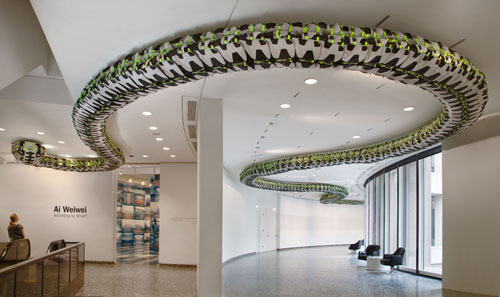
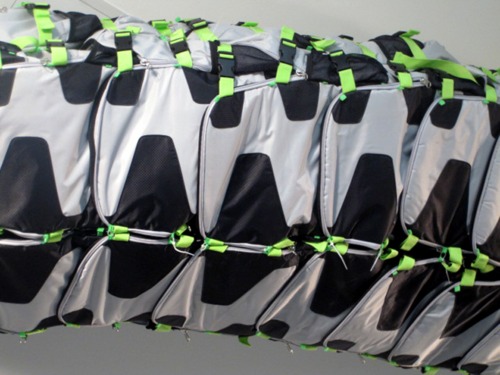
Ai-Weiwei-Snake-Ceiling ai-weiwei.snake-ceiling.bookbags.close-up

“Snake Ceiling”. Left hand image by Cathy Carver from the Hirshhorn website (link shown above). Right hand image by Zimbio

“Snake Ceiling” is made of hundreds of grey and green school backpacks, commemorating  the thousands of children that died in the earthquake. Remember that many children were in school at the time the quake hit. They lost their lives because school buildings were constructed poorly, the construction industry is in the pockets of politicians and vice versa and corruption is rampant. Their deaths were unnecessary. You can’t walk under that massive, aggressive snake without feeling helpless, angry, and intensely sad. Rationally knowing that thousands of children lost their lives is not the same as being confronted with all those backpacks, each representing a happy child that danced to school that morning, before being lost forever, leaving broken lives and futures.

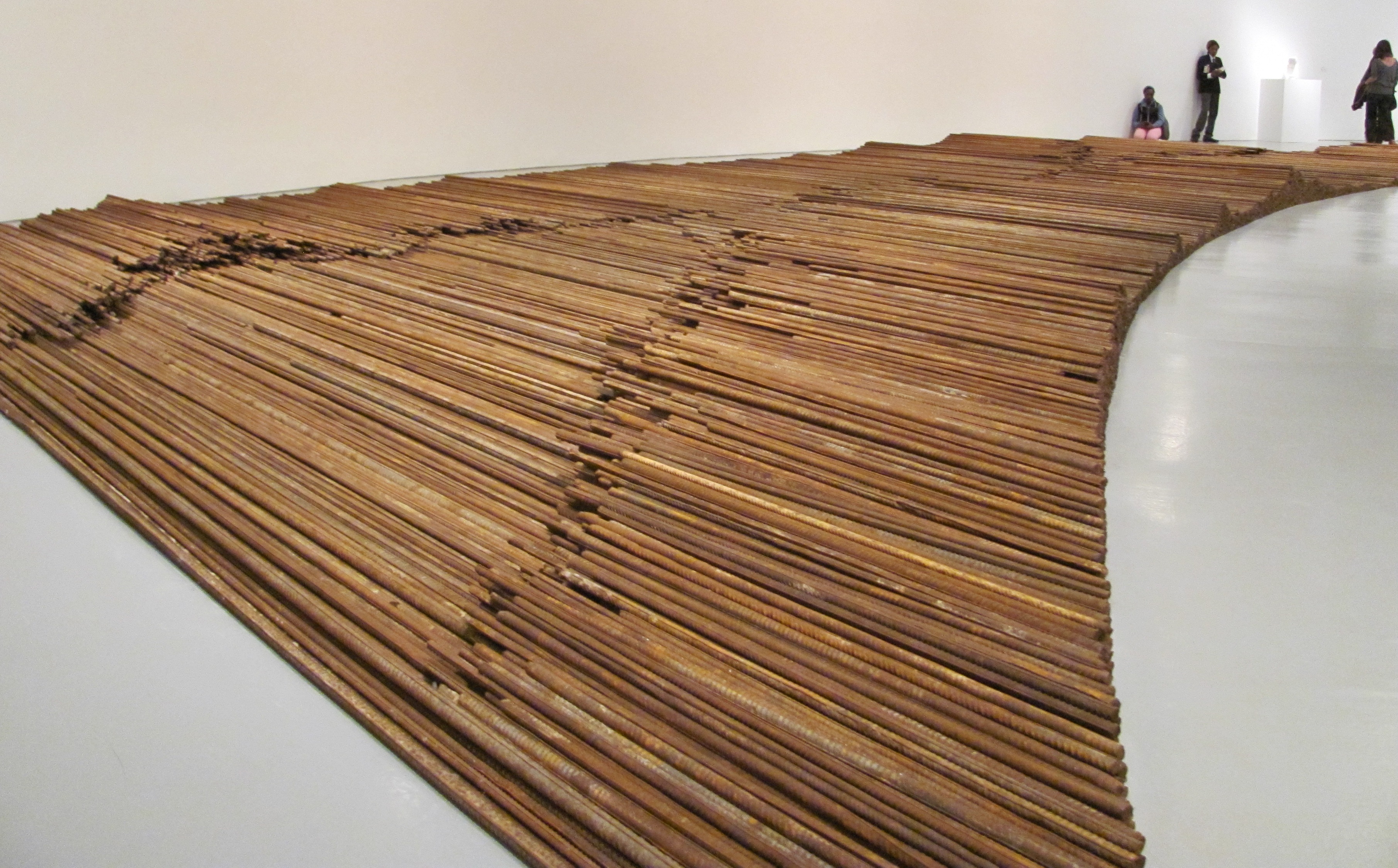
Another work addressing the same corruption problem consists of an enormous pile of elegantly and minimalistically arranged rebar (photo below). Every single one of these rebar pieces was salvaged from collapsed buildings, brought to a recycling place and straightened out for the artist. Together, they form a monstrous monument to corruption and needlessly lost lives.

???????????????????????????????

There were a lot more works addressing China’s corruption and censorship at this exhibit. My general feeling was – if those of use who try to communicate the importance of science to the public would only have access to more artists, if we cooperate more with artists, would our message not improve significantly?

Posted in General geoscience, Geoscience and Art, Natural hazards | Tagged , , , , , , | Leave a comment

Whereof one cannot speak, thereof one must be silent

When the Canadian Minister of Natural Resources, Joe Oliver, proclaimed this week in an official press conference that our concern for climate change was ‘exaggerated’, the press rightly fell over him. There is a good summary of that controversial event here: http://o.canada.com/2013/04/12/blog-joe-oliver-casts-doubt-on-climate-science-in-defence-of-oilsands/ . Do read it if you missed the hullabaloo.

Joe Oliver has no background in science. He has a law degree and an MBA and then went on to work in investment banking and securities. Read his CV here: http://www.nrcan.gc.ca/media-room/minister/1955.

The only thing I could think of when I was confronted with this last bit of evidence-denying ideological political game playing of our Federal Government was Ludwig Wittgenstein’s last proposition, the title of this post.

Full disclosure: I am not a philosopher, I was educated in earth sciences and those degree programs were woefully lacking in philosophy and history of science, which I only discovered much later. I read bits of Karl Popper’s work, all of Thomas Kuhn’s ‘The structure of scientific revolutions’ and the occasional article here and there, among others about Wittgenstein’s work (by the way, did you know that his brother Paul Wittgenstein lost an arm in WWI and that Maurice Ravel wrote his now-famous piano concerto for the left hand for him?).

Ludwig Wittgenstein’s “Tractatus Logico-Philosophicus” is one of the world’s foremost philosophical works and it consists only of a hefty series of propositions. The book has been sitting around here for a while and I promise I’ll start reading it after I finish writing this post.

Of course, you shouldn’t speak about things that you know nothing about. Scientists find that self-evident. Isn’t that what science is all about? You try to move forward in your little corner of the sciences, you work according to the rigorous principles of the scientific method, you present your results at a conference and your audience says “how do you know”? “what is your evidence?” “why didn’t you think of collecting other samples/data?” etc. It’s intimidating when you’re young and then it becomes a sport that you wallow in. You start to feel confident, you’re on top of the data, you know where your conclusions come from and where your research should be going and you can answer the questions with authority. You’re making progress.

That’s what Pablo Casals, one of the world’s most famous cellists said when he was asked, at age 80, if he was still practicing. Oh yes, he was still practicing. The interviewer asked why, still, after all this fame and at this age, he was still practicing. His answer: “I think I’m making progress”. He hit the nail on the head – and everyone who is passionate about a trade, an art or his or her science, knows what he meant: we practice and practice and we try to make progress, but we never give up practicing.

And we teach our students these principles as well. Just last week, I was the external reader for a BSc-level thesis. The student had done an impressive amount of work but of course there were loose ends. When it was my turn, I started with a question about one of those loose ends. She hesitated a moment and then said “I don’t know”. I was proud of her! No waffle speak, no trying to come up with something that sounds intelligent but has been fabricated just to sound smart, just “I don’t know”.

There it was: “whereof one cannot speak, thereof one must be silent”. My student will do well, she will continue to practice (she has been accepted in an MSc program), she will continue to grow and she will contribute to our understanding of the earth. That’s progress.

Try that, Joe Oliver

Posted in Uncategorized | Tagged , , , | Leave a comment

Dear Dr. Johnston, Your Excellency

Your appointment as Governor General of Canada was an excellent choice. You are a person of stellar reputation. As a scientist, I was thrilled that a scientist of your stature was appointed to this office.

During your relatively short term in this Office, you have witnessed the erosion of Canada’s knowledge base (the termination of the Long Form, the closure of PEARL, ELA, air quality and seismic monitoring stations, etc. etc.), accompanied by increasing censorship and muzzling of government scientists. Today, the pages of the website of the National Round Table of Economy and the Environment (http://nrtee-trnee.ca/), of which you were the founding chair (an organization that was eliminated by the current government), were censored by the minister of the environment.

This leaves you in a strange position: you are – in vernacular terms – “the boss” of this government, specifically of the prime minister. Yet the prime minister has silenced you. Surely this is against the law?

Where does this leave you? And where does it leave Canada? How long must Canada endure this onslaught? As you wrote so eloquently in your paragraph on the NRTEE website, the strength of that body was in the belief that cooperation and listening to each other could bring about positive change. And it did. Back then.

The practices of this government, including those of today that silenced you, deny all this.

I ask you to act on behalf of your current position. You are ‘the boss’ of this country. You have a duty to provide leadership and call these people, who obviously have contempt not only for basic democratic values but also for the authority of your office, to order. A gesture from you could mark a beginning, a turning point in what is now a rapid downfall from everything that Canada once stood for.

Sincerely,

Elisabeth C. Kosters, PhD

======

I e-mailed this letter on the same day that I posted it here, and received an answer today, April 3. Here it is in it’s entirety:

On behalf of His Excellency the Right Honourable David Johnston, I am responding to your email below.

Your kind words of support and encouragement are very much appreciated. The Governor General is grateful for the opportunity to serve as The Queen’s representative in Canada and enjoys hearing from Canadians. Thank you for sharing your point of view with His Excellency.

Please accept my best wishes.

Yours sincerely,

Antoine Morin – INFO
Rideau Hall
1 Sussex Drive / 1, promenade Sussex
Ottawa (Ontario) K1A 0A1
info@gg.ca

Posted in Uncategorized | Tagged , , , | Leave a comment

Rise to the challenge: #$5millionforscience

Two weeks ago the Canadian government announced the creation of a Federal office for Religious Freedom. It will cost Canadian tax payers $5 million per year.

Many Canadians, including myself, do not believe this is a good money destination.

Many Canadians, including myself, are very disturbed about our government’s slashing of science funding, the elimination of funding for the Environmental Lakes Area the most blatant example.

So the obvious challenge is to come up with better ways to spend $5 million. And because this blog is about (earth) science, I want to restrict the challenge to geoscientific issues.

Below are my three choices for spending $5 million. What about yours? Can we make this a challenge? Can we crowdsource $5 million for the best project?

1. Bottom Water Formation in the Geologic Past

In 2012 the Council of Canadian Academies (www.scienceadvice.ca) produced a report entitled “40 priority research questions for ocean science in Canada”. It is an important document because it contributes to formulating a national ocean science agenda.

Canada borders three oceans and has a longer coastline than any other country in the world. Yet Canada isn’t a full member of the International Ocean Drilling Program (www.iodp.org, to be renamed International Ocean Discovery Program). Canada participates as a member of the European Consortium for Ocean Drilling and has no more rights to set international ocean science research than any European country, large or small.

It cannot be stressed enough how understanding oceans, past and present, is crucial to improving the understanding of our planet and by extension to being good stewards of our planet. So I would happily give $5 million to a project that addresses a question under the general theme ‘How did the oceans function under past climates?’ This is one of the 40 questions articulated in the CCA report. Understanding the formation of Bottom Water (which oxygenates the deep oceans) in the geologic past is particularly important. Today, Bottom water is formed only along Antarctica and in one location in the North Atlantic. The situation today is one with bath-tub shaped N-S oceans, one continent conveniently occupying the South Pole and that continent is – equally conveniently – completely surrounded by oceans. This situation is very different from e.g. the Ordovician-Silurian, just to name an example.

Bottom Water Formation drives oceanic circulation and thus climate. If we don’t understand Bottom Water Formation now, we can’t really begin to model future climates. So a researcher with a particularly novel project addresses this question can count on my $5 million.

2. Fluid flow in (non)porous media.

This is a pragmatic research topic. The exploding production of unconventional oil and gas has parties digging their trenches and I don’t believe we understand the issues at hand well enough to make any judgements at all. Not only do we not really know how well we can make oil and gas flow through shale, we also don’t understand the exchange between deep and shallow groundwater reservoirs well enough. Clearly this topic needs massive amounts of research as we already know that we have massive reserves and these reserves could well help us bridge the period to a carbon-poor energy future. See my February 16 post.

3. The Sediment Budget of Minas Basin

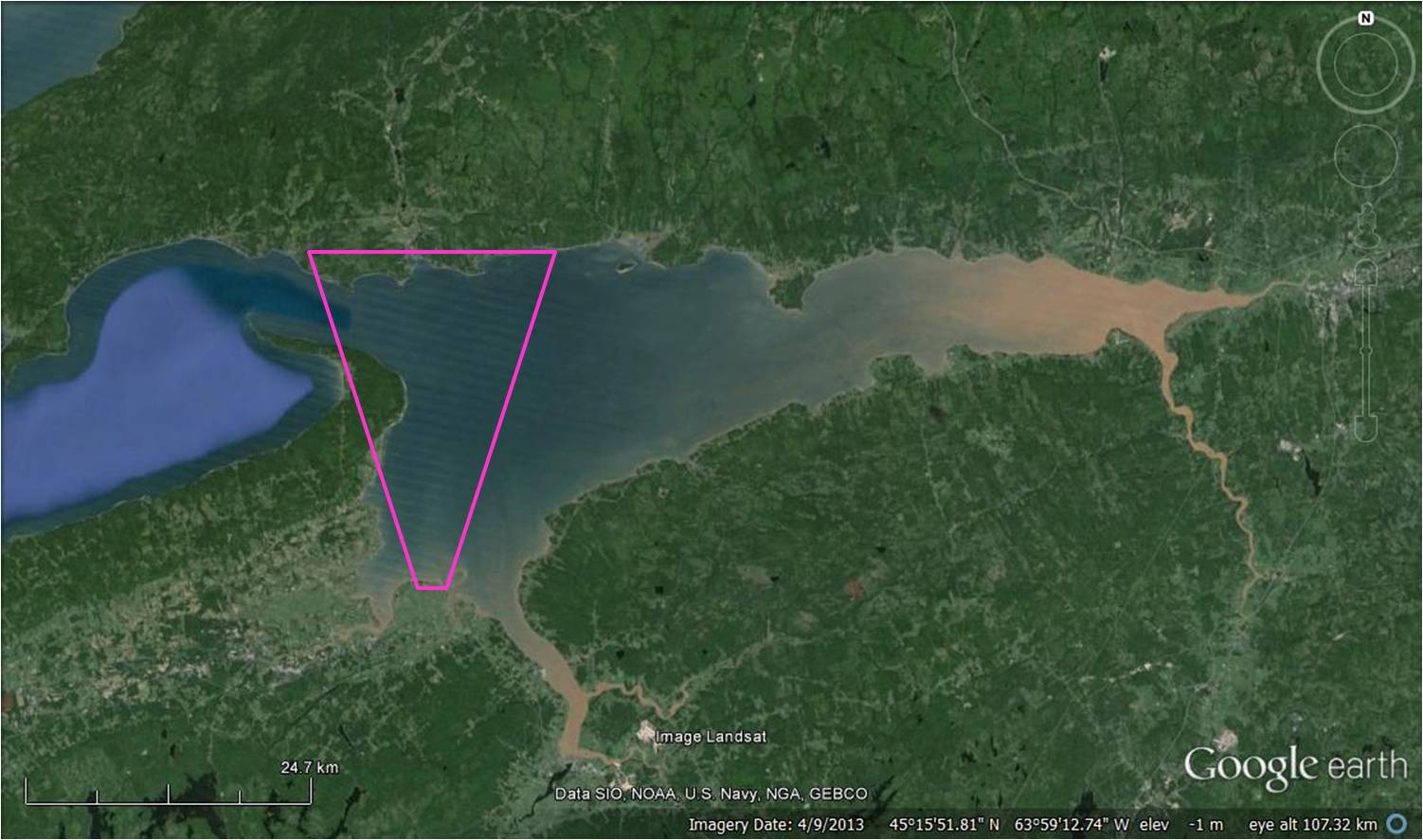
Minas Basin is the eastern arm of the Bay of Fundy (see my posts of December 13 and 20, 2012). The Bay of Fundy separates Nova Scotia from mainland Canada and Minas Basin separates Nova Scotia’s southern mainland from its northern mainland. I live at the southern tip of Minas Basin in the picturesque town of Wolfville.

Minas Basin has the world’s highest recorded tides. running as much as 18 m tide range. A decent image and write-up is here: http://oceanservice.noaa.gov/education/yos/resource/JetStream/ocean/fundy_max.htmThe narrow passage that separates Minas Basin from the Bay of Fundy is called Minas Passage. It is about 4 km wide. More water goes through this passage twice a day than all major rivers of the world deliver to the sea daily. This is not an urban myth, it’s the documented truth. A very good animation of the tides is at http://www.gio.gc.ca/science/research-recherche/ocean/modelling-modelisation/coastalembayments-cotieresdesbaies/images/minas-3-eng.gif. Go to the bottom of the page

People have thought about generating power from these tides for more than 100 years, most recently since 2005. If you would install hundreds of tidal turbines in Minas Passage, you would reduce the current (about 10 cm/sec max) and that would affect sedimentation. Sedimentation in Minas Basin is poorly understood because the environment is so hostile. The one and only attempt at a sediment budget for Minas Basin was published by Amos and Alfoldi in 1979 (full reference below). That sediment budget estimate is one of the best ‘back of an envelope’ exercises known to mankind, but we really need more precise numbers now. Not only because of the potential effects of tidal power development, but also because of potential changes estuarine dynamics caused by climate change. $5 million would probably answer the question.

So, these are my three choices for spending $5 million Federal dollars. Do you have a better proposal?

Amos, C.L. and T.T. Alfoldi, 1979, The determination of suspended sediment in a macrotidal system using Landsat data. Journal of Sedimentary Petrology v. 49, no. 1, p. 159-17

Posted in Uncategorized | Tagged , , , , | Leave a comment

Barrier Island Erosion / Sea Level Rise / Transgressive Anthropogenic Sequences /

Thanks to Twitter, I was made aware of a recent US report, entitled “Coastal impact, Adaptation and Vulnerabilities”. A summary of the report is here: http://www.usgs.gov/newsroom/article.asp?ID=3496#.USVxRFc-6OJ.

What caught my attention on that page was the ‘before and after Hurricane Sandy’ photograph of Mantoloking, New Jersey. They are telling images and we have seen a lot of them in the aftermath of hurricane Sandy and other storms. People seemed genuinely surprised at the amount of sand that was moved landwards by the hurricane (in addition to whole buildings that were taken off their foundations and moved about).

These images never cease to amaze me, if only because of the continued dogged persistence by people to build so close to the ocean.

This is not a treatise on barrier island formation. I just use the occasion to share a set of my own photographs.

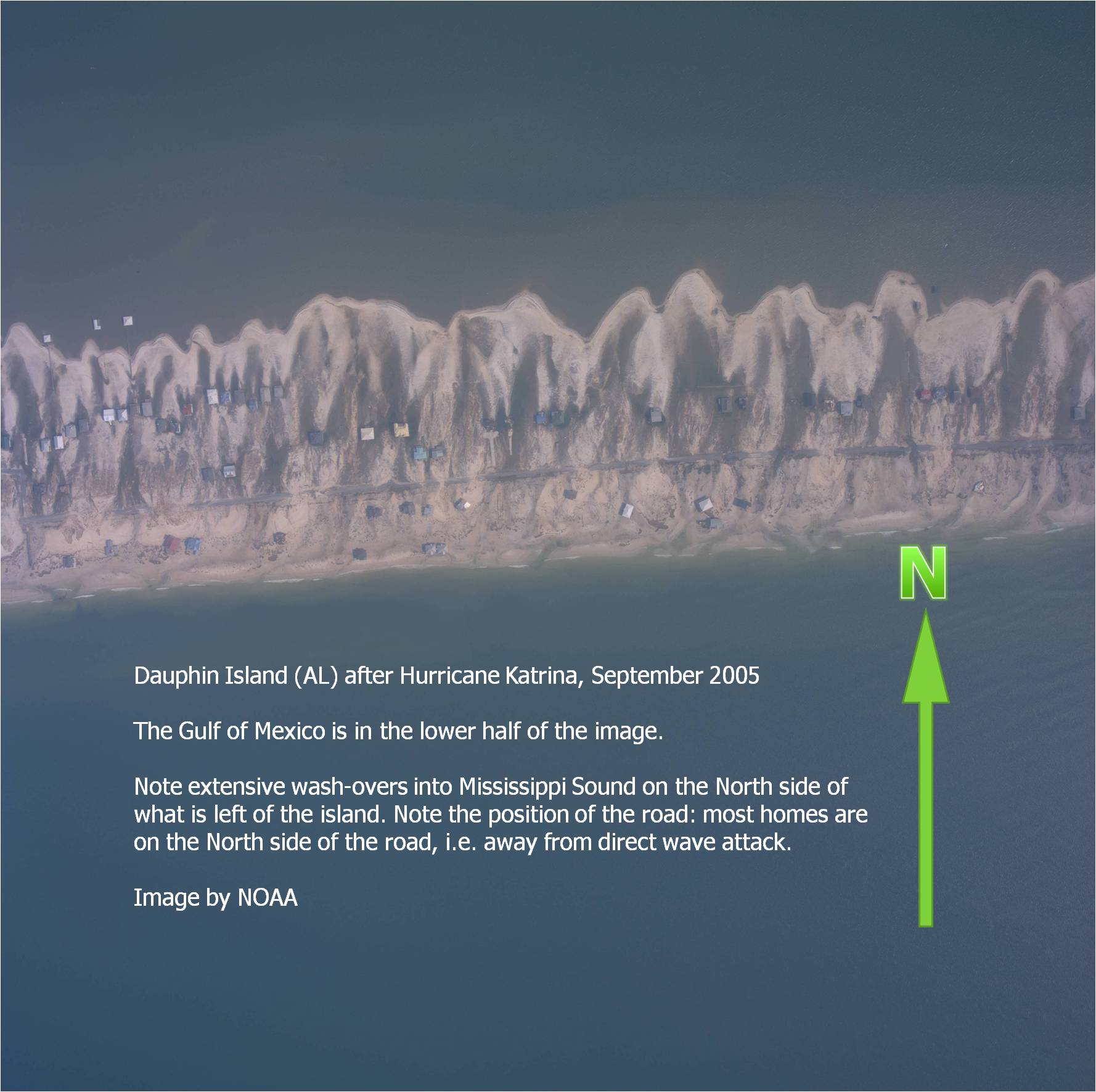
Hurricane Katrina struck the northern Gulf of Mexico on August 28/29, 2005. One of the key research areas for barrier island erosion is Dauphin Island (Alabama) and the USGS and NOAA (the same two organizations responsible for the above cited report) published excellent imagery of Dauphin Island, showing how the hurricane had moved a whopping amount of sediment from the seaward to the landward side of Dauphin Island.

Hurricane Frederic struck Dauphin Island in September of 1979 and I happened to be lucky enough to be doing field work (including an overflight) 6 months later in March of 1980, more than 25 years before Hurricane Katrina. There is one particularly interesting difference over those 25 years and the next few images illustrate that difference:

Dauphin Island 1980 2005 1

This is an image of part of Dauphin Island shortly after Hurricane Katrina. The wash overs are clearly visible. Note the position of the road: most houses (these are all vacation homes) are located on the landward side of the road.

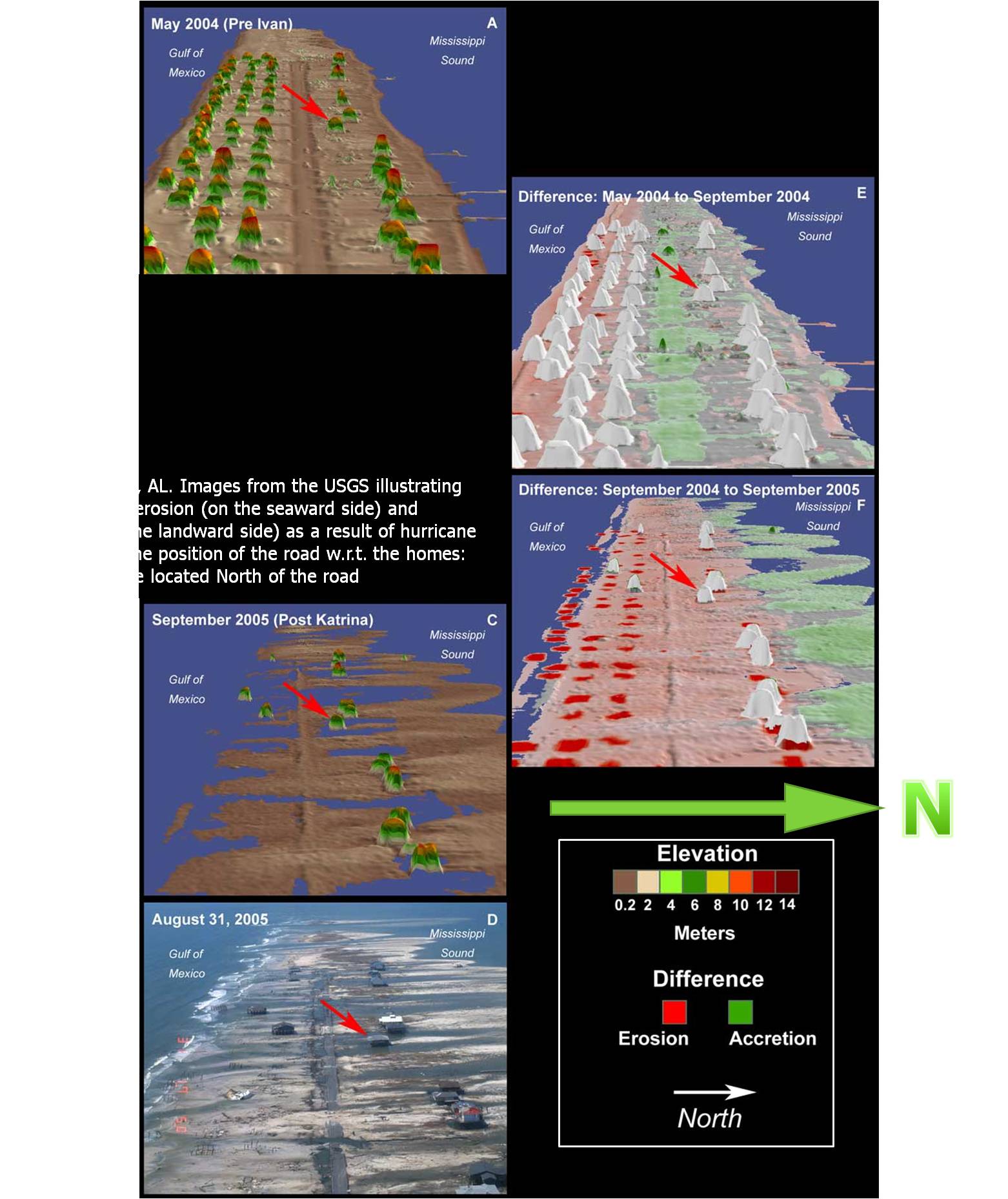
Dauphin Island 1980 2005 2

This is an image compiled by the USGS, showing differential erosion and accretion on Dauphin Island, as a result of Hurricane Katrina. A transgressive system in action.

Dauphin Island 1980 2005 3

These are two images from my 2 days of field work on Dauphin Island in March of 1980. The aerial photo shows identical wash overs, but note the position of the road with respect to the homes! Most homes are on the seaward side of the road………….. Did the road move? NO! The road stayed in the same location; rather, as a result of a number of hurricanes that affected the island over a period of 25 years, homes were destroyed and moved rebuilt further landward. This is an anthropogenic transgressive system in action! Can we call this an ingredient of the Anthropocene?

The field photo shows the depth of the scour by these hurricane wash overs: the man in the photograph is ca. 6 ft (1.80 m) tall.

I do wish Canada would produce similar systematic reports as well.

Posted in General geoscience | Tagged , , , , , , , , , , , , | Leave a comment

Wrong Question: can fracking be done safely?

August 2021

A lot has changed in 8 years. My position on hydraulic fracturing has changed too. I could delete this post, but I’m not going to do that.

A lot has changed: the climate crisis has deepened and the fracking industry has not done well. There are serious Issues with unsafe wastewater storage, using too much groundwater, and wastewater leaking into aquifers. Fracking requires massive numbers of wells, who don’t tend to have a long life and get abandoned. Regulatory regimes are poor and these wells leak methane. The landscape and ecosystems in a region where fracking takes place are destroyed. I’m no longer in favour of this practice. I will update this post later with renewed statistics on Canadian energy use.


February 12, 2015

I published this post in February 2013. I have continued to add material to it, so the most recent bits of info are at the top of the page: scroll down for the original, which hasn’t been changed.

Dr. David Wheeler (president of Cape Breton University), who headed the Nova Scotia (government-appointed) panel on hydraulic fracturing in 2013-2014, gave an excellent speech to the Maritimes Energy Association. It’s an overview of our current and future energy needs and a plea for a Carbon Tax. He published it on his blog: Embracing a new energy future for Atlantic Canada”. Read it!

January 23, 2015

The King’s County Register published my letter about fracking (in Nova Scotia). Read it here.

Ten days after its publication, I received an envelope in the mail, i.e. it was sent to my home address by regular snail mail. There was no return address. The envelope contained the printed version of my letter, with a lot of comments, many of which are illegible. It’s clear that the sender doesn’t agree with me. That’s fine. But I wonder what kind of mentality this is? Clearly this person knows who I am and where I live (note that my address was not published in the paper) and yet decides to take anonymous action. Weird? Childish? Uneducated? All of that and more. Here is the annotated newspaper cut-out:

Advertiser letter anonymously annotated

January 6, 2015

Today I read this excellent objective overview of the State of the Art of hydraulic fracturing – I urge you to read it too. It didn’t change my position as outlined below in my original post.

—-

Original February 2013 Post

Yesterday the Province of New Brunswick announced a new set of regulations pertaining to hydraulic fracturing, commonly known as fracking. A summary of these new rules is here

The host of CBC’s Maritime Noon, Normalee MacLeod, paid attention to this news and asked listeners to react to the question that is the title of this post: can fracking be done safely?

I think that question needs rephrasing.

How about this: “Can we develop hydraulic fracturing of shale gas reserves in a way that is safe for people and the environment?”

I want to rephrase the question because I believe we need to regain ownership of this subject. Most citizens – that is: most vocal citizens – are concerned or opposed to shale gas development and the issued is perceived to be one that’s owned by government and industry and citizens seem to have lost faith in both (at least to some extent, because when the pulp and paper industry imploded, citizens expected the government to bail them out; isn’t that a little opportunistic?).

How did we get here? Why is not everyone deeply involved in trying to be part of changing and regaining control of our energy supplies in order to diminish environmental damage and improve the economic balance? How is it possible that most people have at least some concern about global warming and sea level rise, but at the same time are incapable of connecting that concern to their own situation?

First the facts: natural gas is the least dirty of all fossil fuels. The dirtiest one, i.e. the one producing most CO2 (Greenhouse gas, aka GHG) is coal, then oil, then natural gas. Natural gas (methane) is a really bad GHG before it is burned but not afterwards. President Obama has recently made it abundantly clear that the United States is taking climate change serious and he has pledged to reduce emissions. In fact, the US has already reduced emissions seriously these last 5 years – its emissions are down to the level of 1994, thanks to a shift in electricity generation: coal-fired power plants are rapidly being replaced by gas-powered power plants and this shift is made possible by the massive development of shale gas.

“Environmentalists” (I consider myself an environmentalist, but I doubt that those who are labeled environmentalists by the media would agree that I am one) point out that shale gas development has too many unknown risks:

  • potential groundwater contamination by chemicals used in hydraulic fracturing;
  • leakage from wells (both chemicals and natural gas)
  • the combination of the two is a public health risk

These concerns are realistic, but isn’t it our joint responsibility, our duty as citizens of a democratic society to address them and find solutions? Why turn our backs and dig our heels in? As soon as the NB Government announced its new rules yesterday, various groups in opposition to shale gas development were quick to point out that these rules didn’t solve anything (or words to that effect) and that “gas still emits CO2”. Excuse me? Everyone knows that the world will not be converted to a carbon-free economy overnight, that we need at least 50 years to make significant progress and that – meanwhile – natural gas is the preferred fuel, the so-called “bridging fuel”. It is essential that we develop natural gas at the expense of all other fossil fuels.

HOUSEHOLD ENERGY USE CANADA 2007

This figure (click on it to enlarge it) shows household energy use in Canada as calculated by Statistics Canada for 2007, the most recent year for which data were available. The figures are a little confusing because of the way Statistics Canada calculates the percentages in each jurisdiction, but this graph is what I think represents their data best

The red bar represents natural gas usage. The overall Canadian figure is the one furthest to the left, all jurisdictions are plotted in geographic order, from West to East. The image leaves no doubt: the left side of the graph has a lot of red and there is virtually no natural gas usage east of Ontario. Out here in Nova Scotia, our household energy is supplied mostly by oil (imported mostly from the North Sea) and by electricity (which is produced largely by coal-fired power plants and that coal is imported from Colombia and Venezuela, and I honestly have no idea how environmentally friendly or humane those mining operations are but I’m not hopeful). Both oil and electricity therefore have had to travel thousands of kilometers before usefully feeding our energy needs. We also burn wood, more than any other jurisdiction. I want to address wood fuel in a different post some day. We may not have a lot of people here, but we have an unbelievably irresponsible energy usage for this day and age.

Nova Scotia has some shale gas, New Brunswick has a lot more. The reason for the difference is geological – their Carboniferous basins are a lot thicker than ours. The household energy usage of New Brunswick is comparable to that of Nova Scotia – no gas usage of any significance.

Developing unconventional gas is necessary in order to reduce emissions, regain control of our own energy usage and prevent the severe bleeding of workers to the West of the country.

The Maritime Noon website sports an ad for a Chevrolet Silverado, a car with an average gas mileage that is at best 30% higher than that of a sensible compact…………

Posted in Energy, Nova Scotia | Tagged , , , , , , , | 1 Comment

What is a natural disaster?

I recently watched a very informative webinar by Munich Re. It was their annual webinar on the world’s natural disasters, for 2012 that is. All Munich Re’s webinars are here. I highly recommend dedicating an hour of your time to watch some of these.

Munich Re is the world’s largest re-insurance company, i.e. it’s an insurance company for insurance companies. Because of the nature of that business, Munich Re needs to pay particular attention to natural hazards, since they generate the largest expenditures for insurance companies.

Munich Re distinguishes between the following types of natural hazards:

  1. geophysical hazards: earthquakes, volcanic eruptions and the related tsunamis;
  2. meteorological hazards: storms
  3. hydrological hazards: floods and landslides (they use the term ‘mass movements’)
  4. climatologic hazards: extreme temperatures, drought, fires.

I don’t want to get into the details of semantics here and I don’t want to argue with Munich Re’s categories, even though many landslides are part of the geophysical category and most floods and landslides are the results of storms.

Munich Re maintains an enormous (they claim: the world’s largest) database on these events, going back to 1980. Their figures indicate that all but geophysical hazards are increasing in number. The speakers in the webinar aren’t saying it directly, but they are certainly implying that climate change is the root cause of this increase in globally recorded natural disasters. James Hansen (NASA Goddard Space Centre) has always hypothesized that climate change would go hand in hand with an increase in catastrophic weather events, and this hypothesis is now beginning to be supported with evidence. Canadian figures appear to support the trends reported by Munich Re: the Insurance Bureau of Canada, “which represents the majority of private property and casualty insurers in Canada, says claim payouts from severe weather have doubled every five to 10 years since the 1980s” (CBC article here).

But what exactly is a natural disaster?

As part an undergraduate sedimentology and stratigraphy class, I developed a lab exercise on natural events that shape the earth’s surface and that leave a record in the form of sediments. The objective was to help students gain insight in the frequency and duration of events and then to think about the potential resulting sedimentary rocks.

I asked the students to determine how often an event typically occurred and how long the event would last.

Here is my list of events

  1. Asteroid impact (on the scale of the K/T impact)
  2. Catchment capture
  3. Debris flow
  4. Delta lob switching
  5. Flood basalt eruption
  6. Glacial lake sedimentation
  7. Hurricane / major storm
  8. Pelagic sedimentation
  9. River flood
  10. Sea level fall
  11. Sea level rise
  12. spring/neap tidal sedimentation
  13. surf on a beach
  14. tsunami
  15. turbidity current on an active continental margin
  16. volcanic ash fall

There was always lots of discussion about this list because of the uncertainty of geographic scale. Were debris flow to be considered globally? Were we talking about the surf on one beach or on all beaches of the world? The idea was to limit yourself to thinking about these processes within a sedimentary basin (after all, it was a sedimentary geology class), although some processes clearly had to be considered on a global scale (sea level fall and rise, asteroid impacts).

Each event had to be given a frequency on a scale ranging from of hundreds of millions (108) of years to seconds (10-8 yrs). The recurrence, determined for a specific order of magnitude is the Y-axis of the graph. It’s easy to see that a logarithmic scale with only 16 intervals can be nicely plotted on a (virtual) letter-size piece of paper. In addition, each event had to be given a duration, using the same time scale notation. I then asked the students to rank the events from least frequent to most frequent. The duration would follow.

I gave the students the numbers for glacial lake sedimentation: it occurs once a year (during spring melt) and it lasts maybe a few months. That means that the recurrence is 1, (100) and its duration is 10-1, as a month is more or less 1/10th of a year. It is important to think about more or less, because when you play with orders of magnitude on a 10log basis, then it doesn’t matter if a process lasts for example 3 or 5 years: in both cases it lasts less than 10 years and longer than 1 year, i.e. between two successive intervals.

While there were always some interesting differences between what students came up with, they generally (5 classes, 2 different universities, a 6 year period) came up with a graph that looked more or less like this:

events 1


My result for recurrence and duration of natural events. 

On the far left of the diagram is an asteroid impact. A big impact, such as the one that intercepted with Earth at what we now call the end of the Cretaceous era (65.5 million years ago) only occurs every few hundred million years. You can argue about how long they last, but you end up with figures between seconds and weeks, but certainly not more than that. Such events do big damage and several of these have been tided to so-called ‘mass extinctions’. Example: the end of what we now call the Cretaceous era is defined by the demise of large reptiles (“dinosaurs”) to the advantage – subsequently – of mammals who took over some of the dinosaurs’ niches. Likely that asteroid impact (the Chixtulub) caused the mass-extinction (a lot of other species became extinct as well), although the outflow of the massive basalts of the Deccan traps (in India) more or less around the same time may also have had something to do with it (such basalt outflows pump nasty gases in the atmosphere). Because of all the spectacular research around the finding of the end-of-Cretaceous Chixtulub crater in the Yucatan, the public and many scientists from other disciplines became more aware of these types of events, and we now send probes into spaces looking out for them, a sort of space traffic warden (Douglas Adams, rest his soul, would have a ball at that idea).  There was a bit of interesting press about asteroid Apophis last week. Apophis came in our vicinity, but is not expected to be anywhere close prior to 2036 (maybe).

At the other extreme, to the far right, is ‘surf on a beach’. Within one sedimentary basin it can go on for tens of millions of years, but each crashing wave only lasts a few seconds. We don’t think twice about it. In combination with rising and falling sea level, beach surf may eventually yield extremely thick coastal sedimentary sequences in the rock record.

In between are a whole bunch of other events (or processes, if you wish).

Again, you can argue about some of the details, but about 150 students came up with more or less comparable graphs.

What does this graph tell us? Let’s try to group these events.

events 2

The events on the left have a recurrence that is far longer than any human life span, with a result that humans don’t really worry about them (Apophis mostly caused of a lot of light-hearted banter on Twitter). The events on the right are also not something anyone ever worries or even thinks about much because they simply don’t cause any damage or risk.

But the events in the middle are the ones that worry us. Floods, ash falls, tsunamis, hurricanes, debris flows, and – even if you didn’t think about them – turbidity currents, because they (triggered by earthquakes) may cause tsunamis. These events, in the middle of a spectrum of natural events (and this list is not complete, you can dream up a whole bunch more, but it doesn’t really change the picture), recur at intervals that make them part of oral history, they become part of the human lifespan. They typically occur at intervals of hundreds to a 1000 years and they generally don’t last long, from seconds to days. Terror, in other words, is what they represent.

So what are natural disasters? Natural disasters are normal events, normal from the perspective of our planet. These processes shape our planet and have shaped it for hundreds, even thousands of millions of years.

Even though they are normal, when and where they occur remains the subject of probability calculations. If you live on the shores of the Gulf of Mexico long enough, you will experience a hurricane (I lived there for 6 years and experienced three hurricanes, fortunately they were relatively mild ones). But you will probably never ever experience an earthquake and associated tsunami. So you buy insurance against hurricane damage, but not against earthquake damage.

What MunichRe is saying is that the recurrence interval of the events that already fall within the spectrum of what we call ‘natural hazards’ is increasing. So there is more risk. Prepare yourself: your insurance premiums will go up.

Posted in General geoscience, Natural hazards | Tagged , , , | Leave a comment

Dear Mr. Carney

That must have been a lovely stay, a “short week” (I’m quoting the Globe and Mail) with your family near the small village of Cheverie on the shores of our beautiful Minas Basin. As a proud constituent of Mr. Brison, I know the location of his house well, as it is the site of his annual constituency BBQ, always a terrific party with great music on that magic spot, the big field on top of the cliff overlooking the basin.

You must have frequently walked down to the beach at the end of the road (maybe you even went for a swim during those 2 hours around high tide) and I hope you took a moment to ponder the unusual sight there of a small outcrop of brilliant white rock shown in this picture with the steeple of the Cheverie church above it: cheverie point at macumber looking from cheverie point

A little closer, it looks almost eerie: TSOP 07 Cheverie anhydrite

This is an outcrop of anhydrite, which is a form of gypsum, if you wish. The gypsum belongs to what geoscientists call the ‘Windsor Group’, an assemblage of limestone, gypsum and salt that crops out (geoscience term for: ‘visible to the human eye without digging or excavating’) in the area around Cheverie. I’m sure you saw these outcrops on your drive to your holiday location. Nova Scotia has a lot of gypsum, an indispensable building material. The gypsum mine between Scott Brison’s house in Cheverie and his constituency office in Wolfville ran for about 80 years until it closed recently, one of the many victims of the global recession. It’s hard to get that gypsum out, as it needs to be shipped out of a basin with the world’s highest tides, hence the time window for ships to come in, load and turn around, is very short. Ingenious process technology was invented to meet those conditions, some of which you can still see at the wharf in Hantsport, but that ingeniousness made the whole process quite expensive, explaining why it recently collapsed.

Gypsum precipitates when seawater evaporates in shallow seas in hot wet climates. The gypsum (or anhydrite, to be correct) near Cheverie precipitated in shallow seas more than 300 million years ago, when what is now Nova Scotia was located more or less at the equator. Yes, we moved up quite a bit! Oddly enough, just below that gypsum are rocks that are full of organic material, even coal. Coal is fossil plant material and becomes preserved in hot wet climates, a situation that is diametrically opposed to the one in which gypsum precipitates. There is not yet a good explanation for this sudden climatic about-face. During hot and wet conditions, wide rivers ran through a lush green landscape, in which thick peat bogs (our future coal) accumulated. It was very fertile ground, where the first amphibians set foot on land in search of abundant food. Right in front of Scott Brison’s house is a surface, representing a fossil river bank, full of indentations that mark the location of of fossil trees: cheverie point tree roots in horton 1  cheverie point tree roots in horton3

Amazing, isn’t it? There are lots more amazing rocks along that same shore. I’m sure you saw the red rocks as well. They are the deposits of wild rivers that ran through a near desert environment in the middle of a gigantic continent. They look rusty red and that’s exactly what explains their colour: rust. The iron in these sediments became oxidized due to exposure to air. There was no sea or ocean anywhere at that time. These rocks are more than 200 million years old and Nova Scotia was located at about 15 degrees North at the time, the same latitude as many of the world’s great deserts now. It was a bleak time in the history of the earth, because the planet had just experienced a massive extinction which did away with 95% of all life. You won’t find a lot of fossils in those rocks, but there is evidence of some of the first dinosaur-like creatures in them. Most of these have been found along the north shore of Minas Basin near Parrsboro (where the lampposts are decorated with dinosaur lights).

And every day when you woke up, you looked across this magnificent basin and saw that big Cape on the horizon. That’s Cape Blomidon, a named that was morphed from ‘Blow Me Down’ (there is a place on the West coast of Newfoundland that also has that name, by the way). You can’t see a lot of detail in Blomidon from Cheverie, but maybe you took a day trip around the basin and visited Blomidon Provincial Park or even hiked Cape Split. I insert a picture of Blomidon here (taken on a very cold overflight one winter to photograph the ice in the basin): 668-6844_IMG

There is solid looking rock on top of Blomidon, very different in colour and texture than the underlying red rocks. The solid looking rock on top of Cape Blomidon is basalt. Basalt is definitely not a sediment. Basalt is extruded from the earth’s interior during times of so-called continent break-up. Pretty much like what happens in East Africa today where the Great Rift Valley marks a tear in the continent. The basalts of Cape Blomidon are about 200 million years old and mark the time when the Atlantic Ocean began to form.

And in between all this is loose sediment that may still become rock some day in the geologic future: the tidal sediments of Minas Basin and its eastern extremity Cobequid Bay, exposed only for a few hours, as shown here: met voetjes. Did you go and watch the tidal bore somewhere? I’m sure you learned about the efforts at generating electric power from in-stream tidal turbines. It’s not going as fast as everyone had hoped, but that’s because nature continues to be a difficult one to work with. I do hope that we’ll manage to harness the tides one day, so that we can run on cleaner energy while maintaining good stewardship of our unique environment. We should be able to do better than previous generations, who logged the place bare and hid the nutrient-giving marshes around the basin behind dikes. They are now a cherished cultural phenomenon, those dikes, but they do wreak havoc with ecosystem balances.

Did you come across a wonderful book called “The last Billion Years” (http://www.nimbus.ca/Last-Billion-Years-The-P5316.aspx) in Scott’s library? It tells the story of the geologic history of the Maritimes for the general public. I don’t mean to be disrespectful, you are not an average member of the general public, but you may not have a geosciences background, so I do recommend it highly.

In closing, I hope that you will tell many of your important relations here in Canada and, starting later this year in the UK, about our wondrous, amazing, natural environment which supported our economy, but – in a modern world with different economic drivers – also caused our decline. Raw resources alone are not sufficient to build a long term stable economy, value-added products is what builds a better chance at longer term prosperity. In the near future, we can hopefully capitalize somewhat on our unique geoheritage through the development of geoparks, building on the fame of the Joggins Fossil Cliffs World Heritage Site (http://jogginsfossilcliffs.net/)

With best wishes for a bright future on the other side of that ocean of which you observed the very beginnings right here on your holiday,

Elisabeth

Posted in Nova Scotia | Tagged , , , , , , , , , , , , , | Leave a comment

The tidal landscape banner photo: Minas Basin, Nova Scotia, Canada

cropped-616-1628_img3.jpg

UPDATED December 29, 2014

This was my blog’s banner photo until January 1, 2015. What are you looking at? In a world of Google Earth where everyone has a GPS in their cell phone, I should start with the coordinates. You are standing at 450 6’ N, 200 33’ W, and you are looking North.

Minas Basin with banner photo location

Minas Basin, Nova Scotia. The pink trapezoid indicates the view in the banner photo

You are on the south shore of Minas Basin, which is the eastern arm of the Bay of Fundy, and this place has the world’s highest recorded tides: the average tide range (difference between mean high tide and mean low tide) is about 12 m, but it can increase to as much as 16 m.

The basin is about 80 km wide in an E-W direction and about 30 km at its largest N-S extent. It has a semi-diurnal tide (2 highs and 2 lows for each lunar day) and all that water comes in through the narrow Minas Passage. Actual tide charts are at http://tides.mobilegeographics.com/calendar/month/3799.html .

Minas Basin is surrounded by cliffs. The cliffs are exposed almost exclusively in soft sedimentary rocks, with the exception of the top of the Cape in the distance, which is exposed in Basalt. The cliffs therefore erode rapidly and new exposures are constant.

So this place is pretty much heaven for a sedimentologist. Which is what I am. I first became truly hooked on (clastic!) sedimentology while doing fieldwork for my Master’s thesis research in the macrotidal estuaries of the southwestern Netherlands, where the tide ranges is “only” about 4.5 m tide range.

This banner photo is pretty much the view from our house, which incorporates my office. I can’t think of living in a more interesting place, given that the people here are also really terrific.

Earth scientists categorize tide ranges as micro-(<2m), meso- (2-4m), macro (4-6m) or  hypertidal (>6m). Minas Basin and only a handful of other estuaries in the world are a category of their own with their extreme tide ranges. The only estuary that bears any comparison to Minas Basin is Knik Arm in Alaska, which has a 10 m average tide range.  Like Nova Scotia, that area was heavily glaciated during the Pleistocene and the glaciers left thick packages of sediments (tills, eskers, drumlines etc.). Also, Knik Arm is routinely covered in winter ice.

Another area of hypertides is is Ungava Bay in northern Quebec, which might actually have a marginally higher tide range than Minas Basin (difficult to measure), but there are no glacial deposits around Ungava Bay, because the area was scraped clean by the ice caps, leaving only bare rock exposed (easy to see on Google Earth). Famous for its extreme tides and tidal bore is the Bristol Channel / Severn estuary, separating South Wales from Dorset and Cornwall. Southern Wales was under ice caps during the maximum Pleistocene ice extent, but the ice didn’t reach across the Bristol Channel. The Gulf stream keeps this part of the world ice free year-round, even though it is at about 52deg N.

The extreme tide range of Minas Basin means that there is virtually no shipping. Too dangerous, the currents are as fast as Usain Bolt when he runs the 100 m dash. There are a couple dozen commercial fishing boats in this basin. Until a few years ago, especially designed vessels transported gypsum out of the basin, but the recession ended the demand for gyprock and the mine is now closed. In summer, we kayak here, though. We use a 2.5 hour time window just before high tide. It makes for interesting adventures.

Few people live here, but the interventions over the centuries have been more significant than you might imagine. About which more some other time.

Posted in General geoscience, Minas Basin, Bay of Fundy, Nova Scotia | Tagged , , , , , , , , , , | 2 Comments

Rachel Carson – as relevant today as she was 50 years ago

There is a new biography of Rachel Carson, the author of “Silent Spring”, which was published 50 years ago this year. The biography is by William Souder and is entitled “On a Farther Shore: The Life and Legacy of Rachel Carson”.

Full disclosure: I didn’t read “Silent Spring”. Of course I have been aware of it for as long as I can remember. The book came out in the year I turned 10, but I grew up in the Netherlands and so it took until I was a student in the ’70s to become aware of it. And by that time the book was already iconic, legendary and its thesis generally unquestioned.

I didn’t read the biography either, but I just finished reading a review of it in the New York Review of Books (Tim Flannery, “A heroine in Defense of Nature”, http://www.nybooks.com). By the way, if you can read only one periodical, then read the NY Review of books, which is about much more than just book reviews.

The most shocking bit of information that I learned from this article is this: in the early 1950’s, Eastman Kodak (in Rochester, NY) discovered streaks on its unexposed X-ray film. It turned out that the cardboard packaging of the film was radioactive. Why? It was produced in Iowa and Indiana by paper mills that used water from mid-western rivers, which were under the influence of radio-active fallout from the Nevada test site……

I am a baby boomer. We were born and lived our early years on a planet that experienced frequent and constant above ground nuclear testing. What that did to our health, nobody knows, because you can’t separate that influence from the influence of other poisons that we were routinely exposed to, such as pesticides, the main subject of Rachel Carson’s “Silent Spring”. Incidentally, it was her publisher who came up with that harrowing title.

Rachel Carson was already a well-known and popular nature writer when she published “Silent Spring”, so there was immediately a lot of attention for her new book. President Kennedy referred to it in a press conference that Fall in answering a question about curtailing the use of pesticides. But the chemical industry went on full attack, calling her subversive, a communist sympathizer, anti-business, a health nut, a pacifist and, predictably, a spinster.

Fast forward to 2012. In terms of pesticide use, the western world has accepted its detrimental effects. Environmental protection measures have improved matters significantly, although it could have been better. But society still struggles with (big) industry’s strong-arm tactics, and certain earth resources industries are not exempt from that behaviour either. Will they be proud of their present-day attitudes 50 years from now?

Rachel Carson felt that she had no choice but to write Silent Spring, quoting Abraham Lincoln: “to sin by silence when they should protest makes cowards of men”.

Posted in Women in geoscience | Tagged , , | Leave a comment

A day to celebrate women in Science: Kiek Jelgersma

October 16 is Ada Lovelace day, a day to celebrate inspiring women in science.

What a great opportunity to write about two women geoscientists who I admired and knew.

First I will write about Dr. Saskia Jelgersma, better known as ‘Kiek’ (for Saskia). Kiek passed away in May of this year at age 82. There is an excellent obituary in English of her on the site of the Telegraph: http://www.telegraph.co.uk/news/obituaries/9317540/Saskia-Jelgersma.html. Do read it.

Kiek was a Quaternarist – she worked her entire career on the Quaternary, more specifically on the Holocene, the most recent 10,000 years of Earth history. Hers is the yet to be improved Holocene Sea Level curve of the Netherlands, the result of her PhD dissertation in 1961. To produce a scientific result that stands uncontested for this long is an astonishing accomplishment and points to her drive for perfection.

Kiek was fearless, loud, and – at times – abrasive. She was also loyal to the core, passionate about her science (and about anything else she happened to delve into). I met her a few times and became friendly with her (that wasn’t easy). I think she was the only working female geoscientist in the Netherlands for the first 15 years of her career. And there weren’t very many afterwards, certainly not until she retired (for a few years around 1990, I was one of them).

The Telegraph obituary mentions that she was awarded the ‘Van Waterschoot van der Gracht’ medal of the Royal Netherlands Geological and Mining Society (www.kngmg.nl) in 1997 at a special symposium (organized in her honour), entitled ‘Sea level and Science Fiction’. Yes! That’s true, I was president of KNGMG at the time and I organized that symposium and I had the privilege of presenting her with the medal. It was the first time I wrote a citation speech, and I discovered I loved doing that. Maybe this was the first and only time that Kiek was quiet, subdued, but only for a minute. When I finished reading the citation, she came up to the podium and whispered to me ‘this is a big moment for me, a big moment…’ (in Dutch ‘een groot moment’). To this day, she is the only woman ever awarded this medal, the highest honour of KNGMG.

Posted in Women in geoscience | Tagged , | Leave a comment